Category- Allopathy
About Griseofulvin 250 mg
Griseofulvin 250 mg tablet is an antifungal medicine. Griseofulvin 250 mg is used to treat fungal infections of the skin, scalp, hair, and nails, especially when creams are not effective. Griseofulvin 250 mg works by stopping fungal growth and binding to keratin, making the skin, hair, and nails resistant to infection so that new healthy tissue gradually replaces the infected part. It is usually taken once or twice daily w to improve absorption, and the duration of treatment may range from a few weeks for skin infections to several months for nail infections. Common side effects of Griseofulvin 250 mg are headache, nausea, vomiting, diarrhea, rash, dizziness, and sensitivity to sunlight, while rare side effects may include liver problems or serious allergic reactions.
It should be avoided in people with allergy to the drug, liver disease, or during pregnancy. Griseofulvin 250 mg tablet should not be taken with alcohol and birth control pills as it may cause interactions. Avoid consuming more than 1 gram of Griseofulvin 250 mg. Overdose may cause tremors, chest pain, fast or irregular heartbeat, nervousness, dizziness and headache. In case of any of these symptoms, seek immediate medical help.
Medicine Highlights
| Uses | 1. To treat fungal infections of the skin and scalp (ringworm) 2. To treat fungal infections of nails (onychomycosis) 3. To treat athlete’s foot and jock itch |
| Common Side Effects | 1. Headache 2. Nausea 3. Vomiting 4. Diarrhea 5. Skin rash or itching 6. Dizziness |
| Additional Information | This medicine should only be used under medical supervision. |
| Storage | 1. The medicine should be stored at room temperature. 2. Keep away from sunlight and moisture. 3. Keep away from the reach of children |
| How to Take This Medicine | Take this medicine orally with a sip of water. |
Griseofulvin 250 mg Uses
Griseofulvin 250 mg is an antifungal medicine that belongs to the class of antifungals. Griseofulvin 250 mg is used to treat fungal infections in the following areas:
- Skin and scalp
- Nails
- Severe athlete’s foot or jock itch
Griseofulvin 250 mg side effects
More Common
- Headache
- Nausea
- Vomiting
- Diarrhea
- Skin rash
Less Common
- Photosensitivity (skin becomes sensitive to sunlight)
- Dizziness or tiredness
- Liver problems (rare)
- Severe allergic reaction
How Griseofulvin 250 mg works
Griseofulvin 250 mg works by stopping the growth and multiplication of fungi. It interferes with fungal cell division by disrupting structures needed for their growth, so the infection cannot spread. At the same time, it binds to keratin (a protein in skin, hair, and nails) and makes these tissues resistant to fungal infection. As new healthy tissue grows, it gradually replaces the infected part, helping to clear the infection over time.
Safety Measures and Warning
Allergy / Hypersensitivity
If you are allergic to Griseofulvin 250 mg, this medicine can cause rash, swelling, or serious allergic reactions. Tell your doctor before taking this medicine.
Liver disease
If you have liver disease, Griseofulvin 250 mg can affect liver function and may worsen your condition. Inform your doctor before use.
Pregnancy
Avoid during pregnancy as it may harm the baby. Consult your doctor before use.
Sun Sensitivity
Griseofulvin 250 mg can make your skin more sensitive to sunlight, so avoid excessive sun exposure and use sunscreen.
Griseofulvin 250 mg Interaction with Food Product
Griseofulvin 250 mg should be taken with fatty food (like milk, butter, or meals) to improve absorption. Avoid alcohol as it may increase side effects like flushing and fast heartbeat.
Griseofulvin 250 mg Interaction with Other Medicines
Avoid taking Griseofulvin 250 mg with the following medicines, as it may increase or decrease the desired effect, or in worse cases, it could be fatal:
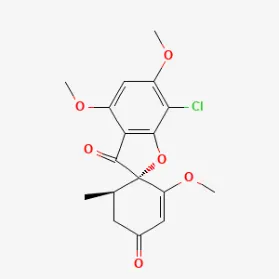
Griseofulvin 250 mg Chemical Structure
IUPAC (International Union of Pure and Applied Chemistry)/ Chemical name
Griseofulvin: (2S,5′R)-7-chloro-3′,4,6-trimethoxy-5′-methylspiro[1-benzofuran-2,4′-cyclohex-2-ene]-1′,3-dione
Intake routine/cycle
Daily dose
Take Griseofulvin 250 mg exactly as your doctor recommends. The dose may change based on your condition and how well you respond. Do not take more than prescribed without consulting your doctor.
Missed Dose
If you forget to take your medicine, take the medication as soon as you remember. If it’s nearly time for your next dose, skip the missed one and continue with your regular schedule. Always consult the doctor before making any changes to your dosage.
Overdose
It is not recommended to take Griseofulvin more than 1 gram per day. Overdose may cause tremors, chest pain, fast or irregular heartbeat, nervousness, dizziness, headache, muscle cramps, or high blood pressure. In case of any of these symptoms, seek immediate medical help.
Storage
- Store the medicine at room temperature.
- Keep away from sunlight and moisture.
- Keep out of reach of children
Directions for use
- Take Griseofulvin 250 mg exactly as prescribed by your doctor, at the same time each day.
- Do not stop taking Griseofulvin 250 mg without your doctor’s approval, even if you feel better.
- If you forget to take Griseofulvin 250 mg, take them as soon as you remember. If it’s almost time for your next dose, skip the missed dose.
FAQ’s
What are the uses of Griseofulvin 250 mg tablets?
Griseofulvin 250 mg tablets are used to treat fungal infections of the skin, scalp, hair, and nails. It is commonly used for ringworm, scalp infections (tinea capitis), nail infections, and severe cases of athlete’s foot or jock itch when creams are not effective.
What is the mechanism of action of Griseofulvin 250 mg?
Griseofulvin 250 mg works by stopping the growth of fungi. It interferes with fungal cell division and also binds to keratin in the skin, hair, and nails, making them resistant to infection. This helps new healthy tissue grow and slowly replace the infected part.
What are the side effects of Griseofulvin 250 mg?
Common side effects include headache, nausea, vomiting, diarrhea, skin rash, dizziness, and increased sensitivity to sunlight. In rare cases, it may cause liver problems or serious allergic reactions.
What is the dosage and duration of Griseofulvin 250 mg?
The dosage and duration depend on the type and severity of the infection. It is usually taken once or twice daily with food. Skin infections may take a few weeks to heal, scalp infections may take around 6–8 weeks, and nail infections may require several months of treatment. Always take it as prescribed and complete the full course.
Reference
- PubChem. Griseofulvin [Internet]. pubchem.ncbi.nlm.nih.gov. Available from
- Griseofulvin Dosage Guide + Max Dose, Adjustments [Internet]. Drugs.com. Available from
- Olson JM, Belgam Syed SY, Goyal A. Microtubule Assembly Inhibitors (Griseofulvin) [Internet]. PubMed. Treasure Island (FL): StatPearls Publishing; 2020. Available from
Authors


Pranathi is a final year Pharm D student at Chalapathi Institute of Pharmaceutical Sciences. She loves learning and applying her knowledge in pharmacy and has a passion for writing, which allows her to express ideas clearly and creatively. She enjoys combining her technical skills with her love for writing and communication to make a meaningful impact. Currently she is working on a research paper about “Consanguineous marriages and its impact on children’s health” which will be published by the end of 2025.