Category- Allopathy
Medicine Highlights
| Uses | To treat Parkinson’s disease (a brain condition that affects movement and causes shaking, stiffness, and slow walking) |
| Common Side Effects | 1. Headache (mild head pain) 2. Dizziness (feeling lightheaded or unsteady) 3. Nausea (feeling like vomiting) 4. Joint pain 5. Indigestion (stomach discomfort) 6. Insomnia (difficulty sleeping) |
| Additional Information | To keep you safe and healthy, use this medicine only with your doctor’s guidance. |
| Storage | 1. The medicine should be stored at room temperature. 2. Keep away from sunlight and moisture. 3. Keep away from the reach of children |
| How to Take This Medicine | Take this medicine orally with a sip of water. |
Rasagiline Uses
Rasagiline is an oral medicine belonging to the category of MAO-B inhibitors (anti-Parkinson medicines) and is used to treat Parkinson’s disease (a brain disorder that affects movement and causes tremors, stiffness, and slow movements)
Rasagiline side effects
More Common
- Headache (mild head pain)
- Dizziness (feeling lightheaded)
- Nausea (feeling like vomiting)
- Dry mouth
- Joint pain
- Difficulty sleeping (insomnia)
Less Common
- Dyskinesia (uncontrolled body movements)
- Hallucinations (seeing or hearing things that are not real)
- Low blood pressure
How Rasagiline works
Rasagiline works by selectively inhibiting the monoamine oxidase-B (MAO-B) enzyme in the brain. This enzyme normally breaks down dopamine (a brain chemical responsible for controlling movement). In Parkinson’s disease, dopamine levels are already low. By blocking MAO-B, rasagiline prevents the breakdown of dopamine, thereby increasing its levels in the brain. This helps improve movement control, reduce stiffness, and tremors.
Safety Measures and Warning
Allergy or Hypersensitivity
If you are allergic to rasagiline or any ingredient in the medicine, you should avoid it because it can cause severe allergic reactions like rash, swelling, or breathing problems.
Severe Liver Disease
If you have serious liver problems, tell your doctor. Rasagiline is processed in the liver. If the liver is weak, the medicine can build up in the body and increase the risk of side effects.
High Blood Pressure
If your blood pressure is not well controlled, inform your doctor. This medicine may suddenly increase blood pressure in some people.
Rasagiline Interaction with Food Product
Rasagiline can be taken with or without food. However, avoid eating large amounts of aged cheese, fermented foods, processed meats, soy sauce, or red wine, as they may suddenly increase your blood pressure and cause a severe headache or fast heartbeat. It is also better to limit alcohol because it can increase dizziness. Always inform your doctor about your diet and take the medicine at the same time every day.
Rasagiline Interaction with Other Medicines
Avoid taking Rasagiline with the following medicines, as it may increase or decrease the desired effect, or in worse cases, it could be fatal:
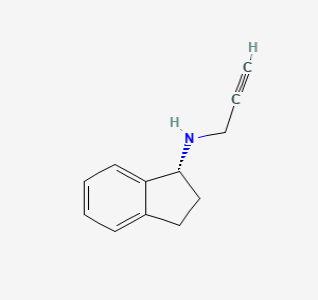
Rasagiline Chemical Structure
IUPAC (International Union of Pure and Applied Chemistry)/ Chemical name
Rasagiline: (1R)-N-prop-2-ynyl-2,3-dihydro-1H-inden-1-amine
Intake routine/cycle
Daily dose
Take Rasagiline exactly as your doctor recommends. The dose may change based on your condition and how well you respond. Do not take more than prescribed without consulting your doctor.
Missed Dose
If you forget to take your medicine, take the medication as soon as you remember. If it’s nearly time for your next dose, skip the missed one and continue with your regular schedule. Always consult the doctor before making any changes to your dosage.
Overdose
It is not recommended for more than 1 mg of rasagiline per day, as it may cause severe adverse effects like nausea, vomiting, diarrhea, dizziness, and in rare cases, seizures.
Storage
- Store the medicine at room temperature.
- Keep away from sunlight and moisture.
- Keep out of reach of children.
Directions for use
- Take this medicine exactly as prescribed by your doctor, at the same time each day.
- Do not stop taking this medicine without your doctor’s approval, even if you feel better.
- If you forget to take this medicine, take it as soon as you remember. If it’s almost time for your next dose, skip the missed dose.
Rasagiline Summary
Rasagiline 1 mg is an anti-Parkinson medicine that belongs to the class of MAO-B inhibitors. It is used to treat Parkinson’s disease and may be given alone in the early stage or along with levodopa in advanced stages to reduce “off” periods and improve movement. It works by blocking the MAO-B enzyme in the brain, which prevents the breakdown of dopamine and increases its levels, helping control tremors, stiffness, and slow movements. Common side effects include headache, dizziness, nausea, insomnia, and sometimes uncontrolled movements when combined with levodopa.
It should not be used in people with severe liver disease, allergy to the drug, or those taking other medicines before consulting doctor as it can cause risk of serious interactions such as serotonin syndrome or high blood pressure. It can be taken with or without food, but large amounts of tyramine-rich foods (like aged cheese and processed meats) and alcohol should be avoided to prevent sudden increases in blood pressure and dizziness.
FAQ’s
What is the mechanism of action of Rasagiline?
Rasagiline works by blocking the MAO-B enzyme in the brain (an enzyme that breaks down dopamine). By blocking this enzyme, it prevents the breakdown of dopamine and increases its level in the brain. Higher dopamine levels help improve movement and reduce symptoms of Parkinson’s disease like tremors, stiffness, and slow movements.
What is the drug class of Rasagiline?
Rasagiline belongs to the class of MAO-B inhibitors (monoamine oxidase-B inhibitors), which are anti-Parkinson medicines that help increase dopamine levels in the brain.
What are the contraindications of Rasagiline?
Rasagiline is contraindicated in patients with severe liver disease, known allergy to rasagiline, and in those taking other MAO inhibitors, certain antidepressants, or opioids like tramadol or meperidine, because combining them can cause serious reactions such as dangerously high blood pressure or serotonin syndrome.
What are the uses of Rasagiline 1 mg?
Rasagiline 1 mg is used to treat Parkinson’s disease. It can be used alone in the early stages to control symptoms like tremors, stiffness, and slow movements, or together with levodopa in advanced stages to reduce “off” periods when symptoms return before the next dose.
Reference
- Rasagiline (Oral Route) Description and Brand Names – Mayo Clinic [Internet]. Available from
- Rasagiline Dosage Guide + Max Dose, Adjustments [Internet]. Drugs.com. 2025 [cited 2026 Feb 27]. Available from
- Keating GM, Lyseng-Williamson KA, Hoy SM. Rasagiline: A Guide to Its Use in Parkinsonʼs Disease. CNS Drugs. 2012 Sep;26(9):781–5.
Authors


Pranathi is a final year Pharm D student at Chalapathi Institute of Pharmaceutical Sciences. She loves learning and applying her knowledge in pharmacy and has a passion for writing, which allows her to express ideas clearly and creatively. She enjoys combining her technical skills with her love for writing and communication to make a meaningful impact. Currently she is working on a research paper about “Consanguineous marriages and its impact on children’s health” which will be published by the end of 2025.