Category- Allopathy
Medicine Highlights
| Uses | 1. To treat acne 2. To treat respiratory tract infections (bronchitis, pneumonia, etc.) 3. To treat urinary tract infections 4. To treat skin and soft tissue infections 5. To treat ear, nose, and throat infections 6. To treat sexually transmitted infections 7. To treat eye infections |
| Common Side Effects | 1. Nausea (feeling sick) 2. Abdominal pain 3. Diarrhoea 4. Headache. |
| Additional Information | 1. This medicine should only be used under medical supervision. 2. This medicine is used only for serious infections 3. Lymecycline is not effective against blood infections. 4. This medicine should not be used in young children because it can cause permanent tooth discoloration and affect bone growth. |
| Storage | 1. The medicine should be stored at room temperature. 2. Keep away from sunlight and moisture. 3. Keep away from the reach of children |
| How to Take This Medicine | Take this medicine orally with a sip of water. |
Lymecycline Uses
Lymecycline, 408 mg, is an antibiotic medicine that is used to kill bacteria. It is mainly used to treat serious infections such as:
- Acne vulgaris (moderate to severe)
- Respiratory tract infections (bronchitis, pneumonia, etc.)
- Urinary tract infections
- Skin and soft tissue infections
- Ear, nose, and throat infections
- Sexually transmitted infections
- Eye infections
Lymecycline side effects
More Common
- Nausea (feeling sick)
- Abdominal pain
- Diarrhea
- Headache.
Less Common
- Disturbances of eyesight
- Dizziness
- Vomiting
- Yellowing of the skin or eyes (jaundice)
- Increased sensitivity of the skin to sunlight
- Increased pressure in the brain
- Changes in the number or type of certain blood cells
- Pain in the upper part of the abdomen
- Changes in some blood tests (tests of liver function)
- Fever
- Itchiness, skin rash or hives
- Inflammation of the intestine
How Lymecycline works
Lymecycline works by blocking the bacteria’s ability to make proteins. This stops the bacteria from growing and spreading. In simple words it shuts down the bacteria’s factory so they cannot survive.
Safety Measures and Warning
Pregnancy
If you are pregnant, inform your doctor, as lymecycline may harm the unborn baby and affect bone and tooth development.
Breastfeeding
If you are breastfeeding, tell your doctor, as this medicine can pass into breast milk and may affect the baby.
Liver Problems
If you have liver problems, inform your doctor, because lymecycline is processed by the liver and may worsen liver function.
Lymecycline Interaction with Food Product
You can eat and drink normally while receiving this medicine, and no special diet is needed. However, eating light meals may help reduce nausea or stomach upset, which are common side effects of lymecycline.
Lymecycline Interaction with Other Medicines
Avoid taking Lymecycline 408 mg with the following medicines, as it may increase or decrease the desired effect, or in worse cases, it could be fatal:
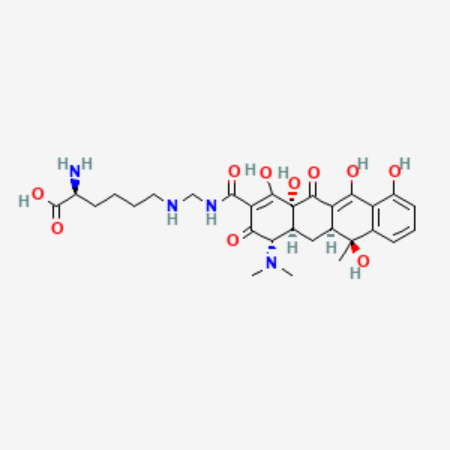
Lymecycline Chemical Structure
IUPAC (International Union of Pure and Applied Chemistry)/ Chemical name
(+)-N-(5-Amino-5-carboxypentylaminomethyl)-4-dimethylamino-1,4,4a,5,5a,6,11,12a-octahydro-3,6,10,12,12a-pentahydroxy-6-methyl-1,11-dioxonaphthacene-2-carboxamide
Intake routine/cycle
Daily dose
Take Lymecycline exactly as your doctor recommends. The dose may change based on your condition and how well you respond. Do not take more than prescribed without consulting your doctor.
Missed Dose
If you forget to take your medicine, take the medication as soon as you remember. If it’s nearly time for your next dose, skip the missed one and continue with your regular schedule. Always consult the doctor before making any changes to your dosage.
Overdose
It is not recommended to take more than 2000 mg per day. Overdose may cause tremors, chest pain, fast or irregular heartbeat, nervousness, dizziness, headache, muscle cramps, or high blood pressure. In case of any of these symptoms, seek immediate medical help.
Storage
- Store the medicine at room temperature.
- Keep away from sunlight and moisture.
- Keep out of reach of children.
Directions for use
- Take lymecycline exactly as prescribed by your doctor, at the same time each day.
- Do not stop taking lymecycline without your doctor’s approval, even if you feel better.
- If you forget to take lymecycline, take it as soon as you remember. If it’s almost time for your next dose, skip the missed dose.
Lymecycline Summary
Lymecycline 408 mg is an antibiotic from the tetracycline class mainly approved for treating acne, and various infections like respiratory, urinary, skin, gastrointestinal, eye, and sexually transmitted infections. It works by stopping bacteria from making proteins so they cannot grow. Common side effects are nausea, diarrhea, stomach pain, headache, and sensitivity to sunlight. It should not be taken with milk, dairy, iron, or antacids, as these reduce action. People with liver or kidney problems, pregnant women, children under 12, and those allergic to tetracyclines should avoid it. Taking more than 2000 mg of this medicine can cause severe nausea, vomiting, dizziness, liver or kidney damage, and raised pressure inside the skull.
FAQ’s
What are the uses of lymecycline?
Lymecycline is a tetracycline antibiotic mainly used to treat acne vulgaris and other bacterial infections by stopping bacterial growth. It is not effective against viral infections and is prescribed for conditions like pimples, respiratory tract infections, and urinary tract infections.
What are the common side effects of lymecycline?
The common side effects of lymecycline include nausea, stomach pain, diarrhea, and headaches. These are usually mild and manageable, but if they persist or worsen, medical advice should be sought.
What is the drug class of lymecycline?
Lymecycline belongs to the tetracycline class of antibiotics.
What are the drug-food interactions of lymecycline?
Lymecycline can interact with certain foods and supplements that reduce its absorption or increase side effects. Dairy products, antacids, and supplements containing calcium, iron, magnesium, or zinc can bind to the drug and lower its effectiveness, while alcohol and oral retinoids may increase risks such as liver toxicity or intracranial hypertension.
Reference
- NHS. About lymecycline [Internet]. London: NHS; 2022 Jan 6 [cited 2026 Feb 25]. Available from.
- Lexon (UK) Limited. Lymecycline 408 mg capsules, hard: patient information leaflet [Internet]. Redditch (UK): Lexon (UK) Ltd; 2017 May 11 [cited 2026 Feb 25]. Available from.
- Elsevier. Lymecycline [Internet]. Amsterdam: ScienceDirect; [cited 2026 Feb 25]. Available from.
- Dubertret L, Alirezai M, Rostain G, Lahfa M, Forsea D, Niculae BD, Simola M, Horvath A, Mizzi F. The use of lymecycline in the treatment of moderate to severe acne vulgaris: a comparison of the efficacy and safety of two dosing regimens. Eur J Dermatol. Available from.
- PubChem [Internet]. Bethesda (MD): National Library of Medicine (US), National Center for Biotechnology Information; 2004-. PubChem Compound Summary for Lymecycline; [cited 2026 Feb. 25]. Available from.
Authors



Siva Krishna Adithya Bhumireddy completed a Bachelor of Pharmacy from GIET School of Pharmacy, affiliated with Andhra University, and from his 3rd year of graduation, he was working as a freelance medical and publication writer. Having expertise in systematic reviews and clinical research. With his keen interest and skills in research and documentation practices, he also reviewed more than 150 manuscripts from international journals like Elsevier, Springer Nature, and Sage Journals, and all the manuscripts were indexed and appeared in PubMed, Scopus, and Web of Science databases, and he received honorary recognition letters and certificates from all of them. Siva Krishna Adithya also published a few systematic, narrative reviews and a few chapters of international expertise.