Category- Allopathy
Medicine Highlights
| Uses | 1. To treat fungal infections 2. To treat ringworm of the body, foot and groin caused by Trichophyton spp. 3. To treat onychomycosis (nail fungus) 4. To treat yeast infections of the skin. |
| Common Side Effects | 1. Burning, stinging, itching, or tingling of treated skin (especially during the first few days of treatment) 2. Viral skin infection 3. Your skin being more sensitive to hot or cold temperatures 4. Acne, redness or crusting around your hair follicles 5. Upset stomach 6. Headache, muscle pain 7. Runny or stuffy nose 8. Fever, chills, body aches, sore throat, cough, swollen glands. |
| Additional Information | 1. To be used for external application only 2. Wash hands after application to avoid accidental contact with eyes or mouth. 3. It is used off-label for tinea capitis (ringworm on the scalp). |
| Storage | 1. The medicine should be stored at room temperature. 2. Keep away from sunlight and moisture. 3. Keep away from the reach of children. |
| How to Take This Medicine | Take this medication orally with a sip of water. |
Terbinafine Uses
Terbinafine 500 mg is an oral medicine belonging to the class of antifungal medicines and used for the treatment of all types of ringworm and yeast infections on skin caused by fungus.
Terbinafine side effects
More Common
- Burning, stinging, itching, or tingling of treated skin (especially during the first few days of treatment)
- Viral skin infection
- Your skin being more sensitive to hot or cold temperatures
- Acne, redness or crusting around your hair follicles
- Upset stomach
- Headache, muscle pain
- Runny or stuffy nose
- Fever, chills, body aches, sore throat, cough, swollen glands.
Less Common
- Feeling very tired or weak
- Joint or muscle pain
- Dizziness
- Yellowing of skin or eyes (sign of liver problem)
- Dark-colored urine
- Severe skin rash or blisters
- Trouble breathing or swelling of face/lips
How Terbinafine works
Terbinafine kills fungus by stopping it from making a substance called ergosterol. Without ergosterol, the fungus cannot build a strong wall to protect itself in human body. This makes the fungus weak, and it dies, clearing the infection.
Safety Measures and Warning
Pregnancy or Breastfeeding
Tell your doctor if you are pregnant, planning to become pregnant, or breastfeeding, as this medicine may harm your baby.
Allergies
Tell your doctor if you have ever had any unusual or allergic reaction to terbinafine or any other antifungal medicine. Taking it again may cause serious allergies, rash, swelling, or breathing problems.
Kidney Problems
If your kidneys do not work well, this medicine may stay in your body for too long and cause harm, so inform your doctor so he may avoid or adjust the dose.
Liver Problems
Do not take this medicine if you have serious liver disease, as terbinafine is processed by the liver and may put additional strain on the liver, potentially worsening your liver problem.
Terbinafine Interaction with Food Product
Desonide does not interact with food products; usually it is applied on the skin only. So, it is safe to use without any fear of food interactions
Terbinafine Interaction with Other Medicines
Avoid taking Terbinafine 500 mg with the following medicines, as it may increase or decrease the desired effect, or in worse cases, it could be fatal:
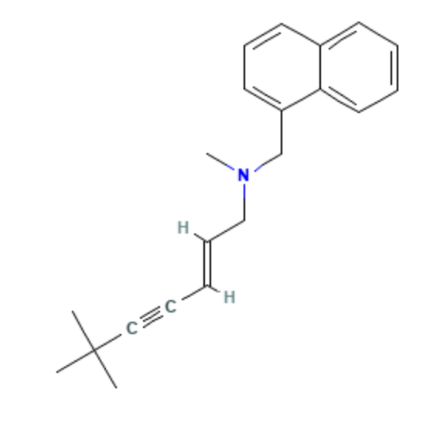
Terbinafine Chemical Structure
IUPAC (International Union of Pure and Applied Chemistry)/ Chemical name
(2E)-6,6-dimethylhept-2-en-4-yn-1-yl(naphthalen-1-ylmethyl)amine.
Intake routine/cycle
Daily dose
Take Terbinafine exactly as your doctor recommends. The dose may change based on your condition and how well you respond. Do not take more than prescribed without consulting your doctor.
Missed Dose
If you forget to take your medicine, take the medication as soon as you remember. If it’s nearly time for your next dose, skip the missed one and continue with your regular schedule. Always consult the doctor before making any changes to your dosage.
Overdose
Apply terbinafine tablet as per doctor’s instructions; do not consume orally. If ingested orally by mistake, overdose symptoms may occur, like nausea, irritations, and vomiting; excessive skin application causes marks on skin and burning sensations.
Storage
- Store the medicine at room temperature
- Keep away from sunlight and moisture
- Keep out of reach of children
Directions for use
- Take terbinafine exactly as prescribed by your doctor, at the same time each day.
- Do not stop taking terbinafine without your doctor’s approval, even if you feel better.
- If you forget to take terbinafine, take it as soon as you remember. If it’s almost time for your next dose, skip the missed dose.
Terbinafine Summary
Terbinafine 500 mg is an antifungal medicine used to treat nail infections and skin problems such as ringworms and athletes’ feet. It works by blocking ergosterol which is needed to build their protective cell wall, so they die off. Common side effects of this medicine are headaches, stomach upset, diarrhea, rash, and changes in taste. Taking this medicine with alcohol or with other medicines that affect the liver can make side effects worse. People with liver problems, kidney problems, or those allergic to terbinafine should inform their doctor before taking this medicine. Taking more than 1,000 mg can cause nausea, vomiting, stomach pain, dizziness, and liver damage.
FAQ’s
What are the side effects of terbinafine tablets?
Common side effects of terbinafine include mild skin irritation, redness, itching, or burning when used as a tablet, and headache, stomach upset, or taste changes when taken orally.
How effective is a terbinafine tablet for ringworm?
Terbinafine tablets are highly effective for ringworm, often clearing the infection within 1 to 2 weeks by directly killing the fungus. Most people notice relief from itching and redness within a few days, but completing the full course prevents recurrence.
What is the mechanism of action of terbinafine?
Terbinafine works by inhibiting the fungal enzyme squalene epoxidase, which blocks the production of ergosterol, an essential component of the fungal cell membrane. This leads to a toxic buildup of squalene inside the fungus, causing its death and clearing the infection.
What is the drug class of terbinafine?
Terbinafine belongs to the allylamine class and belongs to the category of antifungal agents.
Reference
- Stat Pearls [Internet]. Treasure Island (FL): Stat Pearls Publishing; 2025 Jan–. Terbinafine. [Updated 2025 Jan 9]. Available from.
- Mayo Clinic. Terbinafine (topical route): Side effects & dosage [Internet]. Rochester (MN): Mayo Foundation for Medical Education and Research; c2025 [cited 2025 Sep 19]. Available from.
- WebMD. Terbinafine topical (Lamisil, Lamisil AT): Uses, side effects, interactions, pictures, warnings & dosing [Internet]. New York: WebMD LLC; c2025 [updated 2024 Dec 11; cited 2025 Sep 19]. Available from.
- Drugs.com. Terbinafine topical: Uses, side effects & warnings [Internet]. Drugs.com; c1996–2025 [updated 2025 Jul 25; cited 2025 Sep 19]. Available from.
- Practo. Terbinafine 1% tablet: Uses, dosage, side effects, price & composition [Internet]. Bangalore: Practo Technologies Pvt Ltd; c2023 [updated 2023 Feb 21; cited 2025 Sep 19]. Available from.
Authors



Siva Krishna Adithya Bhumireddy completed a Bachelor of Pharmacy from GIET School of Pharmacy, affiliated with Andhra University, and from his 3rd year of graduation, he was working as a freelance medical and publication writer. Having expertise in systematic reviews and clinical research. With his keen interest and skills in research and documentation practices, he also reviewed more than 150 manuscripts from international journals like Elsevier, Springer Nature, and Sage Journals, and all the manuscripts were indexed and appeared in PubMed, Scopus, and Web of Science databases, and he received honorary recognition letters and certificates from all of them. Siva Krishna Adithya also published a few systematic, narrative reviews and a few chapters of international expertise.