Category- Allopathy
Medicine Highlights
| Uses | 1. To treat acidity 2. To treat ulcers (gastric and duodenal ulcers) 3. To control stomach acid pumps up to mouth and burning (gastroesophageal reflux disease) 4. To treat Zollinger-Ellison syndrome (tumors in pancreas and small intestine that release high acids) |
| Common Side Effects | 1. Headache 2. Dizziness 3. Constipation or diarrhea. |
| Additional Information | 1. Take it before the meals to get maximum effect. 2. As this is a prescription medicine, use this medicine with a doctor’s recommendation. |
| Storage | 1. The medicine should be stored at room temperature. 2. Keep away from sunlight and moisture. 3. Keep away from the reach of children |
| How to Take This Medicine | Take this medicine orally with a sip of water |
Esomeprazole Uses
Esomeprazole 40 mg is an oral medicine belonging to the category of proton pump inhibitors and is used for the following indications:
- Acidity
- Gastroesophageal reflux disease (stomach acid pumps up to mouth and burns)
- Ulcers (gastric and duodenal)
- Zollinger-Ellison syndrome (tumors in the pancreas and small intestines that release high acids).
Esomeprazole side effects
More Common
- Headache
- Dizziness
- Constipation or diarrhea.
Less Common
- Confusion, hallucinations, agitation, lack of energy
- Blurred vision
- Dry mouth
- Flushed, dry skin
- Fruit-like breath odor
- Increased hunger
- Increased thirst
- Increased urination
- Nausea
- Stomach pain
- Sweating
- Trouble breathing
- Unexplained weight loss
- Vomiting
How Esomeprazole works
Esomeprazole reduces gastric acid secretion by irreversibly binding to H+/K+ ATPase enzyme in the stomach’s parietal cells, thereby blocking the final step of gastric acid secretion and leading to a sustained reduction in stomach acid production.
Safety Measures and Warning
Breastfeeding
Esomeprazole is considered safe to use while breastfeeding. Only tiny amounts pass into breast milk, which is much less than the dose given, sometimes directly given to newborns for stomach acid problems, so it is not expected to harm the baby
Pregnancy
Esomeprazole is usually safe in pregnancy for acidity and acid reflux, but it should always be taken under medical supervision, at the lowest dose needed.
Liver Problems
Esomeprazole should be used with caution in people who have liver problems, because liver disease can affect how the body processes the medication. In some cases, it can cause a change in liver functioning, so don’t use this, as it can put your liver to work and further damage it.
Esomeprazole Interaction with Food Product
Avoid smoking and consuming alcohol, as they can either increase or decrease the drug’s action and sometimes can cause irritation and reduce the action of medicine.
Esomeprazole Interaction with Other Medicines
Avoid taking Esomeprazole 40 mg with the following medicines, as it may increase or decrease the desired effect, or in worse cases, it could be fatal:
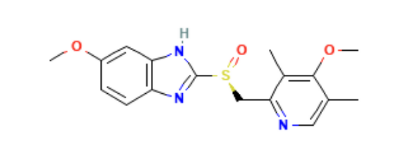
Esomeprazole Chemical Structure
IUPAC (International Union of Pure and Applied Chemistry)/ Chemical name
(S)-5-methoxy-2-[(4-methoxy-3,5-dimethylpyridin-2-yl)methylsulfinyl]-3H-benzimidazole.
Intake routine/cycle
Daily dose
Take Esomeprazole exactly as your doctor recommends. The dose may change based on your condition and how well you respond. Do not take more than prescribed without consulting your doctor.
Missed Dose
If you forget to take your medicine, take the medication as soon as you remember. If it’s nearly time for your next dose, skip the missed one and continue with your regular schedule. Always consult the doctor before making any changes to your dosage.
Overdose
It is not recommended to take more than 220 mg of Esomeprazole per day, as it may cause severe overdosing effects like diarrhea, nausea, dizziness, kidney and liver damage, heart problems, and allergies. If you face any of the severe effects, visit the doctor.
Storage
- Store the medicine at room temperature
- Keep away from sunlight and moisture
- Keep out of reach of children
Directions for use
- Take Esomeprazole exactly as prescribed by your doctor, at the same time each day.
- Do not stop taking Esomeprazole without your doctor’s approval, even if you feel better.
- If you forget to take Esomeprazole, take it as soon as you remember. If it’s almost time for your next dose, skip the missed dose.
Esomeprazole Summary
Esomeprazole is a proton pump inhibitor (PPI) used to treat acid-related conditions like GERD, peptic ulcers, and Zollinger-Ellison syndrome by irreversibly blocking the H⁺/K⁺ ATPase enzyme in stomach lining cells to reduce acid production; it is typically taken once daily before meals, has minimal food interaction, but long-term use may lead to magnesium or vitamin B12 deficiency, increased fracture risk, or infections like Clostridium difficile (a bacterium that causes watery diarrhea); overdose above 240 mg/day is rare and usually mild, but caution is advised in elderly patients or those with liver disease or prolonged therapy due to higher vulnerability to adverse effects.
FAQ’s
What are the uses of Esomeprazole 40 mg?
Esomeprazole is a medicine used to help people with ulcers, acidity, and heartburn in the stomach.
What is the maximum recommended dose of Esomeprazole per day?
It is not recommended to take more than 220 mg of Esomeprazole per day, as it may cause severe overdosing effects like diarrhea, nausea, dizziness, kidney and liver damage, heart problems, and allergies. If you face any of the severe effects, see the doctor.
What are the side effects of Esomeprazole tablets?
Some people may feel mild side effects like headaches, nausea, or changes in bowel movements like constipation or diarrhea while using Esomeprazole.
What is the mechanism of action of Esomeprazole?
Esomeprazole works by irreversibly inhibiting the H⁺/K⁺ ATPase enzyme (proton pump) in the stomach’s parietal cells, thereby blocking the final step of gastric acid secretion and leading to a sustained reduction in stomach acid production.
Reference
- Drugs.com. Esomeprazole: Uses, Dosage, Side Effects. [Internet]. Drugs.com; c1996–2026 [cited 2026 Jan 3]. Available from.
- Practo. Esomeprazole: Uses, Dosage, Side Effects, Price. [Internet]. Practo Technologies Pvt. Ltd.; c2008–2026 [cited 2026 Jan 3]. Available from.
- Mayo Clinic. Esomeprazole (oral route) – Side effects & dosage. Mayo Clinic [Internet]. 2025 Dec 1 [cited 2026 Jan 3]. Available from.
- National Center for Biotechnology Information. PubChem Compound Summary for CID 957740, Esomeprazole. PubChem [Internet]. Bethesda (MD): National Library of Medicine (US); [cited 2026 Jan 3]. Available from.
Authors



Siva Krishna Adithya Bhumireddy completed a Bachelor of Pharmacy from GIET School of Pharmacy, affiliated with Andhra University, and from his 3rd year of graduation, he was working as a freelance medical and publication writer. Having expertise in systematic reviews and clinical research. With his keen interest and skills in research and documentation practices, he also reviewed more than 150 manuscripts from international journals like Elsevier, Springer Nature, and Sage Journals, and all the manuscripts were indexed and appeared in PubMed, Scopus, and Web of Science databases, and he received honorary recognition letters and certificates from all of them. Siva Krishna Adithya also published a few systematic, narrative reviews and a few chapters of international expertise.