Category- Allopathy
Medicine Highlights
| Uses | 1. To treat different types of seizures (generalized tonic-clonic, status epilepticus, and focal seizures) 2. To treat nerve-related pains |
| Common Side Effects | 1. Decreased coordination 2. Mental confusion 3. Nervousness 4. Slurred speech 5. Trouble with breathing, speaking, or swallowing 6. Unsteadiness, trembling, or other problems with muscle control or coordination 7. Trouble sleeping 8. Uncontrolled eye movements |
| Additional Information | 1. Avoid driving or any hazardous activity after consuming phenytoin, as it can cause dizziness or drowsiness. |
| Storage | 1. The medicine should be stored at room temperature. 2. Keep away from sunlight and moisture. 3. Keep away from the reach of children |
| How to Take This Medicine | Take this medicine orally with a sip of water. |
Phenytoin Uses
Phenytoin 300 mg is an oral medicine belonging to the category of anticonvulsants and is used for the management of the following conditions:
- Seizures (generalized tonic-clonic, status epilepticus, and focal seizures)
- Severe nerve-related pain.
Phenytoin side effects
More Common
- Decreased coordination
- Mental confusion
- Nervousness
- Slurred speech
- Trouble with breathing, speaking, or swallowing
- Unsteadiness, trembling, or other problems with muscle control or coordination
- Trouble sleeping
- Uncontrolled eye movements
Less Common
- Bleeding gums
- Blistering, peeling, or loosening of the skin
- Blisters, hives, itching, skin rash
- Bloating of the abdomen or stomach
- Blood in the urine or stools
- Bloody, black, or tarry stools
- Chest pain or discomfort
- Chills
- Cough
- Dark urine
- Diarrhea
- Difficulty with moving
- Fainting spells
- Fever with or without chills
- General feeling of discomfort or illness
- Hair loss
- Headache
- High fever
- Hoarseness
- Irritation in the mouth
- Joint or muscle pain
- Light-colored stools
- Lightheadedness or dizziness
- Lower back or side pain
- Muscle stiffness
- Nausea
- Numbness, tingling, or pain in the hands or feet
- Painful or difficult urination
- Pale skin
- Pinpoint red spots on the skin
- Red skin lesions, often with a purple center
- Red, irritated eyes
- Redness and swelling of the gums
- Slow or irregular heartbeat
- Sore throat
- Sores, ulcers, or white spots on the lips or in the mouth
- Stomach pain
- Swollen, painful, or tender lymph glands in the neck, armpit, or groin
- Unusual bleeding or bruising
- Unusual tiredness or weakness
- Upper right abdominal or stomach pain
- Vomiting
- Weight loss
- Yellow eyes or skin
How Phenytoin works
Phenytoin works by controlling how nerve cells in the brain send electrical signals. Normally, these cells use tiny “sodium channels” to pass messages quickly, but if the channels open too often, the brain becomes overexcited and seizures happen. Phenytoin slows this process by keeping the sodium channels closed for longer, which steadies the flow of signals and prevents sudden bursts of activity that trigger seizures.
Safety Measures and Warning
Pregnancy
Phenytoin can harm an unborn baby, sometimes causing birth defects known as fetal hydantoin syndrome (disease with limb deformities, development issues, and growth issues) . Always consult a doctor to weigh safer alternatives and carefully manage seizures.
Breastfeeding
Phenytoin does pass into breast milk, but usually in small amounts; while many babies tolerate it, there’s a risk of drowsiness or poor feeding. Always talk with a doctor to balance seizure control with the baby’s safety.
Kidney and Liver Problems
Phenytoin is broken down mainly by the liver and partly cleared by the kidneys, so patients with liver disease or kidney problems may not process the drug safely. Patients should consult their doctor before using phenytoin to ensure proper monitoring and safer alternatives if needed.
Brain Problems
Phenytoin can sometimes affect mood and behavior, so patients with a history of mental health problems may be more sensitive to these changes. They should consult their doctor before starting phenytoin to ensure safe use and proper monitoring of their mental well‑being.
Heart Problems
Phenytoin can affect heart rhythm and blood pressure, so patients with existing heart problems may be at higher risk of complications. They should consult their doctor before using phenytoin to ensure it is safe and that their heart health is closely monitored.
Phenytoin Interaction with Food Product
Avoid consuming alcohol and smoking simultaneously, as it may affect the drug’s action and show an effect on the brain, leading to severe drowsiness, sedation, and coma in severe cases.
Phenytoin Interaction with Other Medicines
Avoid taking phenytoin 300 mg with the following medicines, as it may increase or decrease the desired effect, or in worse cases, it could be fatal:
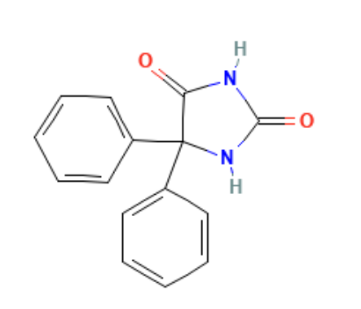
Phenytoin Chemical Structure
IUPAC (International Union of Pure and Applied Chemistry)/ Chemical name
5,5-diphenylimidazolidine-2,4-dione.
Intake routine/cycle
Daily dose
Take Phenytoin exactly as your doctor recommends. The dose may change based on your condition and how well you respond. Do not take more than prescribed without consulting your doctor.
Missed Dose
If you forget to take your medicine, take the medication as soon as you remember. If it’s nearly time for your next dose, skip the missed one and continue with your regular schedule. Always consult the doctor before making any changes to your dosage.
Overdose
It is not recommended to take more than 600 mg of Phenytoin per day, as it may cause severe overdosing effects like extreme drowsiness, confusion, unconsciousness, sweating, double vision, low blood pressure, coma and slurred speech. Immediately seek medical attention and meet the doctor if necessary.
Storage
- Store the medicine at room temperature
- Keep away from sunlight and moisture
- Keep out of reach of children
Directions for use
- Take phenytoin exactly as prescribed by your doctor, at the same time each day.
- Do not stop taking phenytoin without your doctor’s approval, even if you feel better.
- If you forget to take phenytoin, take it as soon as you remember. If it’s almost time for your next dose, skip the missed dose.
Phenytoin Summary
Phenytoin is a medicine from the hydantoin group that helps control seizures, especially the common “fits” seen in epilepsy, long-lasting seizures, or after head injuries (generalized tonic-clonic, status epilepticus, and focal seizures) it works by calming overactive brain signals. It also causes side effects like sleepiness, balance problems, swollen gums, skin rashes, and weak bones if used in the long term. Alcohol, grapefruit juice, and folic acid supplements can interfere with working of the medicine. Taking more than 2 grams of phenytoin causes confusion, slurred speech, coma, or heart problems. Pregnant women, people with liver disease, or those allergic to seizure medications should avoid it because it can interact with other medicines.
FAQ’s
What are the uses of phenytoin tablets?
Phenytoin tablets are used to prevent and control seizures, especially generalized tonic-clonic (grand mal) and focal seizures. They may also be prescribed in emergencies like status epilepticus or to reduce seizure risk after head injuries or brain surgery.
What are the side effects of phenytoin tablets?
Phenytoin tablets can cause side effects such as dizziness, drowsiness, balance problems, swollen gums, skin rashes, and unwanted hair growth, while long-term use may weaken bones or nerves. In rare cases, serious reactions like liver problems or severe skin conditions (Stevens-Johnson syndrome) can occur, so regular medical monitoring is important.
What is the phenytoin drug class?
Phenytoin belongs to the hydantoin class of anticonvulsant drugs, which are medicines designed to stabilize brain activity and prevent seizures.
What is Phenytoin highest dose?
Phenytoin’s highest usual oral dose is about 600 mg per day in adults, though most patients are maintained at 300–400 mg daily.
Reference
- Drugs.com. Phenytoin: Uses, Dosage, Side Effects. [Internet]. Drugs.com; 2025 [cited 2026 Jan 13]. Available from.
- Mayo Clinic. Phenytoin (oral route): Description and proper use. [Internet]. Mayo Foundation for Medical Education and Research; 2025 [cited 2026 Jan 13]. Available from.
- National Center for Biotechnology Information. PubChem Compound Summary for CID 1775, Phenytoin. [Internet]. Bethesda (MD): National Library of Medicine; 2025 [cited 2026 Jan 13]. Available from.
- National Center for Biotechnology Information. Phenytoin. In: StatPearls [Internet]. Treasure Island (FL): StatPearls Publishing; 2025 [cited 2026 Jan 13]. Available from.
Authors



Siva Krishna Adithya Bhumireddy completed a Bachelor of Pharmacy from GIET School of Pharmacy, affiliated with Andhra University, and from his 3rd year of graduation, he was working as a freelance medical and publication writer. Having expertise in systematic reviews and clinical research. With his keen interest and skills in research and documentation practices, he also reviewed more than 150 manuscripts from international journals like Elsevier, Springer Nature, and Sage Journals, and all the manuscripts were indexed and appeared in PubMed, Scopus, and Web of Science databases, and he received honorary recognition letters and certificates from all of them. Siva Krishna Adithya also published a few systematic, narrative reviews and a few chapters of international expertise.