Category- Allopathy
Medicine Highlights
| Uses | 1. To prevent excessive bleeding after delivery, abortion, or miscarriage. |
| Common Side Effects | 1. Headache and dizziness 2. Stomach pain 3. Increase in blood pressure |
| Additional Information | 1. Use this medicine under strict medical guidance only. |
| Storage | 1. The medicine should be stored at room temperature. 2. Keep away from sunlight and moisture. 3. Keep away from the reach of children |
| How to Take This Medicine | Take this medicine orally with a sip of water. |
Methylergometrine Uses
Methylergometrine 0.125 mg is an oral medicine belonging to the category of ergot alkaloids and is used for the management of excessive bleeding after pregnancy and abortion
Methylergometrine side effects
More Common
- Headache and dizziness
- Stomach pain
- Increase in blood pressure
Less Common
- Chest pain
- Increase in blood pressure
- Change in skin color
- Nausea and vomiting
- Skin rash
- Sweating
- Difficulty in breathing
How Methylergometrine works
Methylergometrine works in a simple way by making the womb muscles tighten strongly, which helps stop heavy bleeding after childbirth. At the same time, it also squeezes blood vessels, so less blood is lost.
Safety Measures and Warning
Pregnancy
Methyl ergometrine can be useful in pregnancy care when prescribed by doctors to manage heavy bleeding, but if taken without supervision, it can be dangerous, causing miscarriage, birth defects, or womb rupture.
Breastfeeding
Methyl ergometrine is considered safe during breastfeeding because only tiny amounts pass into breast milk, and these are not expected to harm the baby.
Kidney and Liver Problems
Methylergometrine is unsafe for people with serious kidney or liver problems because the drug can build up in the body and may lead to high blood pressure, chest pain, seizures, or poor blood flow to vital organs, so doctors usually avoid it or use it only with strict monitoring.
Heart Patients
Methyl ergometrine is unsafe for heart patients because it can make blood vessels tighten and raise blood pressure, which may trigger chest pain, heart attack, or irregular heartbeat. Always consult a doctor before using it.
Methylergometrine Interaction with Food Product
Methyl ergometrine works better and is easier on your stomach if taken with food. Avoid spicy, oily, acidic, or very sugary foods, and limit coffee or alcohol, since they can make side effects like diarrhea or cramps worse. Stick to light, bland meals and drink plenty of fluids.
Methylergometrine Interaction with Other Medicines
Avoid taking methylergometrine 0.125 mg with the following medicines, as it may increase or decrease the desired effect, or in worse cases, it could be fatal:
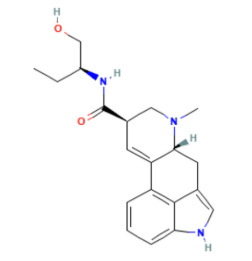
Methylergometrine Chemical Structure
IUPAC (International Union of Pure and Applied Chemistry)/ Chemical name
(6aR,9R)-N-[(2S)-1-hydroxybutan-2-yl]-7-methyl-6,6a,8,9-tetrahydro-4H-indolo[4,3-fg]quinoline-9-carboxamide
Intake routine/cycle
Daily dose
Take methylergometrine exactly as your doctor recommends. The dose may change based on your condition and how well you respond. Do not take more than prescribed without consulting your doctor.
Missed Dose
If you forget to take your medicine, take the medication as soon as you remember. If it’s nearly time for your next dose, skip the missed one and continue with your regular schedule. Always consult the doctor before making any changes to your dosage.
Overdose
It is not recommended to take more than 1 mg of Methyl ergometrine per day, as it may cause severe overdosing effects like extreme drowsiness, confusion, unconsciousness, sweating, high blood pressure, and diarrhea. Immediately seek medical attention and meet the doctor if necessary.
Storage
- Store the medicine at room temperature
- Keep away from sunlight and moisture
- Keep out of reach of children
Directions for use
- Take methylergometrine exactly as prescribed by your doctor, at the same time each day.
- Do not stop taking methylergometrine without your doctor’s approval, even if you feel better.
- If you forget to take methylergometrine, take it as soon as you remember. If it’s almost time for your next dose, skip the missed dose.
Methylergometrine Summary
Methylergometrine 0.125 mg is a semi-synthetic ergot alkaloid medicine used mainly to prevent and control bleeding after childbirth or abortion. It works by stimulating uterine muscles to contract and prevent blood flow from blood vessels. Common side effects include nausea, vomiting, stomach pain, diarrhea, headache, dizziness, sweating, leg cramps, and high blood pressure. It should be avoided by people with hypertension, heart disease, liver, or kidney problems, or those taking strong antibiotics or HIV medicines. Taking this medicine along with grapefruit juice can increase side effects. Taking more than 1 mg of this medicine can cause severe hypertension, chest pain, seizures, confusion, and restricted blood flow to organs.
FAQ’s
What are the side effects of methylergometrine?
Methyl ergometrine tablets can cause headache, nausea, vomiting, stomach pain, diarrhea, dizziness, sweating, and high blood pressure; in rare cases, they may trigger seizures, chest pain, or restricted blood flow to organs.
What are the uses of the methylergometrine tablet?
Methyl ergometrine tablets are mainly used after childbirth or abortion to prevent and control heavy uterine bleeding by tightening the womb muscles.
What is methylergometrine’s highest dose?
The highest recommended dose of methyl ergometrine is usually 200 micrograms per dose, given orally, intramuscularly, or intravenously, and it can be repeated every 2–4 hours up to a maximum of 5 doses in 24 hours (about 1 mg total per day) for controlling postpartum or post-abortion bleeding.
What is the drug class of methylergometrine?
Methylergometrine belongs to the ergot alkaloid drug class, specifically classified as an oxytocic agent that stimulates uterine contractions and acts as a monoamine receptor modulator affecting serotonin and adrenergic pathways.
Reference
- Elsevier. Methylergometrine [Internet]. ScienceDirect Topics; [cited 2026 Feb 19]. Available from.
- PubChem [Internet]. Bethesda (MD): National Library of Medicine (US), National Center for Biotechnology Information; 2004-. PubChem Compound Summary for CID 8226, Methylergometrine; [cited 2026 Feb. 19]. Available from.
- McDonald S, Abbott JM, Higgins SP. Prophylactic ergometrine-oxytocin versus oxytocin for the third stage of labour. Cochrane Database Syst Rev. Available from.
Authors



Siva Krishna Adithya Bhumireddy completed a Bachelor of Pharmacy from GIET School of Pharmacy, affiliated with Andhra University, and from his 3rd year of graduation, he was working as a freelance medical and publication writer. Having expertise in systematic reviews and clinical research. With his keen interest and skills in research and documentation practices, he also reviewed more than 150 manuscripts from international journals like Elsevier, Springer Nature, and Sage Journals, and all the manuscripts were indexed and appeared in PubMed, Scopus, and Web of Science databases, and he received honorary recognition letters and certificates from all of them. Siva Krishna Adithya also published a few systematic, narrative reviews and a few chapters of international expertise.