Category- Allopathy
Medicine Highlights
| Uses | 1- To treat heart failure |
| Common Side Effects | 1- Allergy 2- Chest pain, discomfort, tightness, or heaviness dizziness, lightheadedness, or fainting 3- Generalized swelling or swelling of the feet, ankles, or lower legs 4- Pain 5- Slow heartbeat 6- Trouble breathing 7- Weight gain |
| Additional Information | Avoid taking alcohol or tobacco with this medicine. |
| Storage | 1- The medicine should be stored at room temperature 2- Keep away from sunlight and moisture 3- Keep away from the reach of children |
| How to Take This Medicine | The medicine should be taken orally |
Carvedilol Summary
Carvedilol is a beta-blocker used to treat heart failure and support heart function after a heart attack. It works by slowing your heart rate and relaxing blood vessels to lower blood pressure. It’s important to take it exactly as prescribed- don’t stop suddenly, even if you feel better. Like all medications, it can have side effects, ranging from dizziness and fatigue to more serious issues, so regular check-ins with your doctor are key.
Alongside medication, small lifestyle changes can make a big difference. Staying active, eating heart-healthy foods like leafy greens, oats, and bananas, cutting back on alcohol, quitting smoking, and getting enough sleep all help manage blood pressure. These steps not only support your treatment but can improve your overall well-being too.
Carvedilol Uses
Carvedilol 10 mg is an oral medicine belonging to the class of non-selective beta blocker medicines. It is used for following indications:
- Heart failure
Directions for use
- Take carvedilol exactly as prescribed by your doctor, regularly at the same time each day.
- Do not stop taking carvedilol without your doctor’s approval, even if you feel better.
- If you forget to take the medicine, take it as soon as you remember, unless it’s almost time for the next one, then just skip it.
Carvedilol side effects
More Common
- Allergy
- Chest pain, discomfort, tightness, or heaviness
- Dizziness, lightheadedness, or fainting
- Generalized swelling or swelling of the feet, ankles, or lower legs
- Pain
- Slow heartbeat
- Trouble breathing
- Weight gain
Less Common
- Ankle, knee, or great toe joint pain
- Anxiety
- Arm, back, or jaw pain
- Blood in the urine
- Bloody, black or tarry stools
- Chills
- Cloudy urine
- Cold sweats
- Coma
- Confusion
- Cool pale skin
- Cough
- Dark urine
- Decreased appetite
- Decreased frequency or amount of urine
- Depression
- Difficulty with breathing
- Dizziness, faintness, or lightheadedness when getting up suddenly from a lying position
- Dry mouth
- Fainting
- Fast or irregular heartbeat
- Fever
- Flu-like symptoms
- Flushed, dry skin
- Fruit-like breath odor
- Headache, sudden and severe
- Inability to speak
- Increased blood pressure
- Increased hunger
- Increased thirst
- Increased urination
- Itching
- Joint stiffness or swelling
- Large amount of cholesterol in the blood
- Loss of appetite
- Loss of consciousness
- Lower back, side, or stomach pain
- Mental depression
- Muscle pain or cramps
- Nervousness
- Nightmares
- Noisy, rattling breathing
- Numbness or tingling in the hands, feet, or lips
- Pinpoint red or purple spots on the skin
- Pounding in the ears
- Pounding, slow heartbeat
- Rapid breathing
- Seizures
- Shakiness
- Slurred speech
- Stomachache
- Sweating
- Swelling of the fingers or hands
- Temporary blindness
- Tenderness on the upper right side of the body
- Trouble with breathing even at rest
- Unexplained weight loss
- Unusual bleeding or bruising
- Weakness in the arm and/or leg on one side of the body, sudden and severe
- Weakness or heaviness of the legs
- Yellow eyes or skin
How Carvedilol works
Carvedilol reduces blood pressure by slowing down the heart rate and relaxing blood vessels.
Safety Measures and Warning
1- Coronary Artery Disease
Patients taking carvedilol for the treatment of coronary artery disease should not discontinue the therapy midway and must complete the full course.
2- Pregnancy
It is safe to consume this medicine during pregnancy, as it does not cause any harm to the fetus.
3- Older Patients
Since older patients are more prone to adverse effects from carvedilol, doctors should be cautious when prescribing this medicine and should regularly monitor its effects.
Carvedilol Interaction with Other Medicines
Avoid taking carvedilol 10 mg with the following medicines, as it may increase or decrease the desired effect, or in worse cases, it could be fatal:
Carvedilol Interaction with Food Product
Carvedilol does not interact with any food products, but alcohol should be avoided before and after taking the medicine, as it can increase or decrease the effect of carvedilol.
Storage
- The medicine should be stored at room temperature
- Keep away from sunlight and moisture
- Keep away from the reach of children
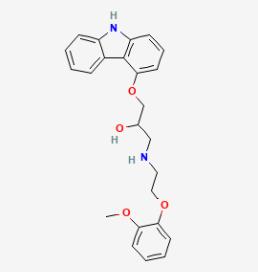
Carvedilol Chemical Structure
IUPAC (International Union of Pure and Applied Chemistry)/ Chemical name-
1-(9H-carbazol-4-yloxy)-3-{[2-(2-methoxyphenoxy)ethyl]amino}propan-2-ol
Intake routine/cycle
Daily dose
Take carvedilol exactly as your doctor recommends. The dose may change based on your condition and how well you respond. Do not take more than prescribed without consulting your doctor.
Missed Dose
If you forget to take your medicine, take the medication soon as you remember. If it’s nearly time for your next dose, skip the missed one and continue with your regular schedule. Always consult the doctor before making any changes to your dosage.
Overdose
Though the actual toxic dose of carvedilol is not known but the symptoms of overdose include chest tightness, shortness of breath, dizziness and low heart rate. If someone you know is taking carvedilol and exhibits any of these symptoms, seek medical attention immediately.
Dietary and Lifestyle Management
A few modifications in your diet and lifestyle can significantly help manage your blood pressure, to the point where your doctor may determine that medication is no longer necessary. Here are some dietary changes and lifestyle practices that can help you manage your blood pressure:
1- Lose Weight
Weight gain is directly linked to higher blood pressure. If you’re overweight or obese, losing weight can help lower your blood pressure. Pay attention to the weight around your waistline as well, excess weight in this area can be a significant risk factor for high blood pressure.
2- Regular Exercise
Exercise can lower your blood pressure by 5 to 8 mm Hg. Engaging in 30 minutes of physical activity daily can significantly help reduce your blood pressure. Activities like walking, jogging, cycling, swimming, and dancing are all effective in keeping your blood pressure under control.
3- Eat Healthy
Choosing a healthy diet not only helps lower your blood pressure but also offers numerous other health benefits. Incorporate the following foods into your diet to help reduce your blood pressure:
- Carrots
- Spinach
- Bananas
- Beetroot
- Watermelon
- Oats
- Green leafy vegetables
- Garlic
- Daal (Lentils)
- Yogurt
- Pomegranates
4- Quit or limit alcohol consumption
The kidney is responsible for maintaining the salt and water balance in our body and producing a hormone called renin, which helps regulate blood pressure. Alcohol damages the kidneys, disrupting their normal functioning. To protect your health, it is best to quit alcohol or, at the very least, limit your intake.
5- Quit Smoking
Cigarettes contain nicotine, an addictive substance that causes blood vessels to constrict, leading to an increase in blood pressure. If you have high blood pressure, it’s crucial to avoid smoking to protect your heart and overall health.
6- Increase your sleep duration
Lack of sleep forces your heart to work harder, causing your blood vessels to constrict, which can lead to high blood pressure. Aiming for 7 to 8 hours of sleep is ideal for those with elevated blood pressure.
FAQ’s
1- Can carvedilol cause weight gain?
Yes, carvedilol can cause weight gain, as it is one of its common symptoms. However, this is typically observed in individuals who have taken carvedilol for a long time.
2- Can carvedilol cause shortness of breath?
Yes, carvedilol can cause shortness of breath or trouble breathing, which is one of its common side effects.
3- Which is better: carvedilol or amlodipine?
Amlodipine is generally preferred for managing primary hypertension due to its strong BP-lowering effect and good tolerability. Carvedilol is used more often in patients with heart failure or post-MI, not as a first-line antihypertensive.
The choice depends on the clinical context and comorbid conditions.
4- When should carvedilol be taken?
If you are taking carvedilol for heart failure, take the medicine without food; otherwise, you can take the medicine once a day, at the same time every 24 hours.
Reference
- Healthline. Carvedilol (Oral Tablet). Healthline [Internet]. 2024 [cited 2024 Dec 19]. Available from.
- Verma U, Bano G, Mohan Lal B, Sharma KP, Sharm R. Antihypertensive efficacy of carvedilol and amlodipine in patients of mild to moderate hypertension–a comparative study. JK science. 2004;6(4):193-6. Available from.
- NHS. How and when to take carvedilol. NHS [Internet]. 2023 [cited 2024 Dec 19]. Available from.
- Singh S, Preuss CV. Carvedilol. [Updated 2024 Jan 10]. In: StatPearls [Internet]. Treasure Island (FL): StatPearls Publishing; 2024 Jan-. Available from.
- Mayo Clinic. Carvedilol (oral route) [Internet]. Rochester (MN): Mayo Foundation for Medical Education and Research; c1998-2024 [cited 2024 Dec 20]. Available from.
- Whelton PK, Carey RM, Aronow WS, Casey DE Jr, Collins KJ, Dennison Himmelfarb C, et al. 2017 ACC/AHA/AAPA/ABC/ACPM/AGS/APhA/ASH/ASPC/NMA/PCNA Guideline for the Prevention, Detection, Evaluation, and Management of High Blood Pressure in Adults. Hypertension. 2018 Jun;71(6):e13–e115. doi:10.1161/HYP.0000000000000065. Available from.
Authors


Mahak Phartyal completed her bachelor’s in pharmacy from Veer Madho Singh Bhandari Uttarakhand Technical University. She previously worked as a Medical Writer at Meril Life Sciences, where she wrote numerous scientific abstracts for conferences such as India Live 2024 and the European Society of Cardiology (ESC). During her college years, she developed a keen research interest and published an article titled “Preliminary Phytochemical Screening, Physicochemical and Fluorescence Analysis of Nyctanthes arbor-tristis and Syzygium cumini Leaves.