Category- Allopathy
Medicine Highlights
| Uses | 1. To treat bacterial infection in eye (bacterial conjunctivitis) |
| Common Side Effects | 1. Eye irritation, burning, pain, or discomfort 2. Watery eyes and increased sensitivity to light 3. Decreased or blurred vision 4. Feeling like something is in the eye 5. Headache and dizziness 6. Dryness or itching of the eyes 7. Rarely, swelling of the eyelid or local allergic reactions 8. In some cases, a change in taste sensation or sore throat |
| Additional Information | Avoid consuming alcohol, tobacco, and cranberries with this medicine. |
| Storage | 1. The medicine should be stored at room temperature 2. Keep away from sunlight and moisture 3. Keep away from the reach of children |
| How to Take This Medicine | This medicine is a liquid used as eye drops. |
Levofloxacin Summary
Levofloxacin 0.5% is an Opthalmic antibiotic used to treat eye infection (conjunctivitis). It works by killing bacteria through blocking an enzyme needed for their survival. Take it exactly as prescribed, at the same time daily, and don’t stop early, even if you feel better. Avoid grapefruit, alcohol, and tobacco, and let your doctor know if you have kidney issues or are pregnant.
Common side effects include diarrhea, while more serious ones can affect your mood, skin, or tendons. Store it at room temperature, away from sunlight and out of children’s reach. If you miss a dose, take it as soon as you remember, unless it’s almost time for the next one. Overdose symptoms like severe stomach pain or dizziness need emergency care right away. Always talk to your doctor before making any changes.
Levofloxacin Uses
Levofloxacin 0.5% is an ophthalmic medicine belonging to the class of quinolone antibiotics medicines. It is used to treat bacterial eye infection (conjunctivitis).
Directions for use
- Take levofloxacin exactly as prescribed by your doctor, regularly at the same time each day.
- Do not stop taking levofloxacin without your doctor’s approval, even if you feel better.
- If you forget to take the medicine, take it as soon as you remember, unless it’s almost time for the next one, then just skip it.
Levofloxacin side effects
More Common
- Eye irritation, burning, pain, or discomfort
- Watery eyes and increased sensitivity to light
- Decreased or blurred vision
- Feeling like something is in the eye
- Headache and dizziness
- Dryness or itching of the eyes
- Rarely, swelling of the eyelid or local allergic reactions
- In some cases, a change in taste sensation or sore throat
Less Common
- Voice changes
- Body aches or pain
- Congestion
- Dryness or soreness of throat
- Runny nose
- Swelling of the eyelid
- Tender, swollen glands in neck
- Trouble in swallowing
- Itching, pain, redness or swelling of eye or eyelid
- Watering of eyes
- Decreased vision
- Fever
- Feeling of having something in the eye
- Headache
- Hoarseness
- Eye burning, dryness, itching, or pain
- Increased sensitivity of eyes to light
How Levofloxacin works
Levofloxacin belongs to the bactericidal category of antibiotics, meaning it kills bacteria rather than merely inhibiting their growth. It does this by preventing the formation of the bacterial cell wall, also known as the skin of the bacteria. This is achieved by inhibiting the production of DNA gyrase, an enzyme essential for bacterial cell wall formation.
Safety Measures and Warning
Kidney Dysfunction
Patients with kidney dysfunction require a 50% dose reduction of this medication. Therefore, if you have kidney dysfunction, inform your doctor so they can either reduce the dose or consider an alternative medication.
Pregnancy
Levofloxacin should be prescribed during pregnancy only if the potential benefits outweigh the potential risks.
Levofloxacin Interaction with Other Medicines
Avoid taking levofloxacin 250 mg with the following medicines, as it may increase or decrease the desired effect, or in worse cases, it could be fatal:
Levofloxacin Interaction with Food Product
You should not consume alcohol and tobacco with this medication as they can increase or decrease the effect of levofloxacin.
Storage
- The medicine should be stored at room temperature
- Keep away from sunlight and moisture
- Keep away from the reach of children
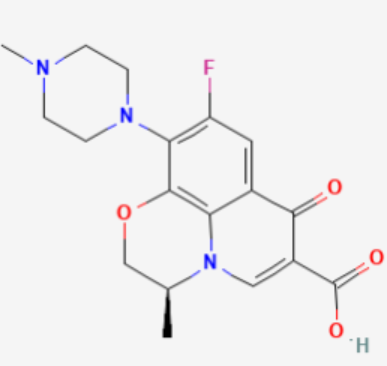
Levofloxacin Chemical Structure
IUPAC (International Union of Pure and Applied Chemistry)/ Chemical name
(S)-9-fluoro-2,3-dihydro-3-methyl-10-(4-methylpiperazin-1-yl)-7-oxo-7H-pyrido[1,2,3-de]-1,4-benzoxazine-6-carboxylic acid
Intake routine/cycle
Daily Dose
Take levofloxacin exactly as your doctor recommends. The dose may change based on your condition and how well you respond. Do not take more than prescribed without consulting your doctor.
Missed Dose
If you forget to take your medicine, take the medication soon as you remember. If it’s nearly time for your next dose, skip the missed one and continue with your regular schedule. Always consult the doctor before making any changes to your dosage.
Overdose
The symptoms of levofloxacin overdose include severe stomach pain, watery stools that may contain blood, increased heart rate, shortness of breath, and dizziness. If you know someone who is taking this medication and experiences any of these symptoms, seek immediate medical attention and take them to the hospital without delay.
FAQ’s
What are levofloxacin eye drops uses?
Levofloxacin 0.5% is an ophthalmic medicine belonging to the class of quinolone antibiotics medicines. It is used to treat bacterial eye infection (conjunctivitis).
Reference
- Podder V, Patel P, Sadiq NM. Levofloxacin. [Updated 2024 Mar 1]. In: StatPearls [Internet]. Treasure Island (FL): StatPearls Publishing; 2025 Jan-. Available from.
- Mayo Clinic Staff. Levofloxacin (ophthalmic route) [Internet]. Rochester (MN): Mayo Foundation for Medical Education and Research; [cited 2025 Jun 2]. Available from. Available from.
- AHMAD M, Bashir B, AKHTAR MS, Irfan M, ADIL MA, Hashmi ZY. TYPHOID FEVER: CLINICAL EXPERIENCE WITH LEVOFLOXACIN, ITS EFFICACY AND SAFETY. The Professional Medical Journal. 2007 Oct 12;14(04):620-6. Available from.
- WebMD. Levofloxacin ophthalmic (Quixin, Iquix) – Uses, side effects, and more [Internet]. WebMD; [cited 2025 Jun 2]. Available from
Authors


Mahak Phartyal completed her bachelor’s in pharmacy from Veer Madho Singh Bhandari Uttarakhand Technical University. She previously worked as a Medical Writer at Meril Life Sciences, where she wrote numerous scientific abstracts for conferences such as India Live 2024 and the European Society of Cardiology (ESC). During her college years, she developed a keen research interest and published an article titled “Preliminary Phytochemical Screening, Physicochemical and Fluorescence Analysis of Nyctanthes arbor-tristis and Syzygium cumini Leaves.