Category- Allopathy
Medicine Highlights
| Uses | 1. To treat and prevent outbreak of genital herpes 2. To treat Chickenpox 3. To treat Shingles |
| Common Side Effects | 1. Pain, swelling or redness |
| Additional Information | Avoid taking alcohol or tobacco with this medicine. |
| Storage | 1- The medicine should be stored at room temperature 2- Keep away from sunlight and moisture 3- Keep away from the reach of children |
| How to Take This Medicine | The medicine should be taken orally |
Acyclovir Summary
Acyclovir 400 mg effervescent tablet is an antiviral medicine used to treat conditions like genital herpes, chickenpox, and shingles. It works by stopping the virus from multiplying. Take it exactly as prescribed, don’t skip doses or take more than recommended. Common side effects include redness, swelling, or tiredness, and more serious issues can occur if taken improperly. If someone overdoses or shows unusual symptoms, get medical help immediately.
Let your doctor know if you’re pregnant, have kidney issues, or a weakened immune system, as acyclovir can pose risks in these cases. Avoid alcohol while on this medication. Store it in a cool, dry place out of children’s reach. Always talk to your doctor before making any changes to your dose or if you’re taking other medications.
Acyclovir Uses
Acyclovir 400 mg effervescent tablet is an oral medicine belonging to the class of antivirals medicines. It is used for following indications:
- Genital herpes
- Chickenpox
- Shingles
Acyclovir side effects
More Common
- Pain, swelling, or redness
Less Common
- Abdominal or stomach pain
- Decreased frequency of urination or amount of urine
- Increased thirst
- Loss of appetite
- Nausea or vomiting
- Unusual tiredness or weakness
How Acyclovir works
Acyclovir works by tricking viruses like herpes and chickenpox. It pretends to be part of the virus’s DNA, but once the virus uses it, it can not keep copying itself. To show its action, acyclovir needs to be activated by the virus first. In most healthy people, this medicine works really well. But in people with weak immune systems, like those who had a stem cell transplant, the virus can sometimes learn to ignore the medicine and keep spreading.
Directions for use
- Take acyclovir exactly as prescribed by your doctor, regularly at the same time each day.
- Do not stop taking acyclovir without your doctor’s approval, even if you feel better.
- If you forget to take the medicine, take it as soon as you remember, unless it’s almost time for the next one, then just skip it.
Safety Measures and Warning
Pregnancy
Acyclovir can easily cross the placental barrier and reach the fetus. Although studies on the use of acyclovir during pregnancy are limited, it is important to inform your doctor if you are pregnant or planning to conceive.
Kidney Dysfunction
Since this medicine is excreted through the kidneys and its use may further impair kidney function, it is best to inform your doctor if you have any kidney-related conditions.
Weak Immune System
People with weakened immune systems should inform their doctor, as taking this medication may increase the risk of developing conditions such as thrombotic thrombocytopenic purpura (TTP) and hemolytic uremic syndrome (HUS).
Acyclovir Interaction with Other Medicines
Avoid taking acyclovir 400 mg with the following medicines, as it may increase or decrease the desired effect, or in worse cases, it could be fatal:
Acyclovir Interaction with Food Product
Acyclovir does not interact with any food products, but alcohol should be avoided before and after taking the medicine, as it can increase or decrease the effect of the medicine.
Storage
- The medicine should be stored at room temperature
- Keep away from sunlight and moisture
- Keep away from the reach of children
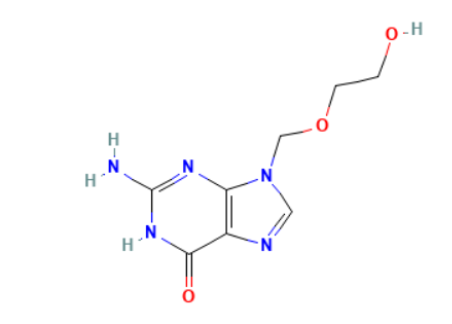
Acyclovir Chemical Structure
IUPAC (International Union of Pure and Applied Chemistry)/ Chemical name
2-amino-9-(2-hydroxyethoxymethyl)-1H-purin-6-one.
Intake routine/cycle
Daily Dose
Take acyclovir exactly as your doctor recommends. The dose may change based on your condition and how well you respond. Do not take more than prescribed without consulting your doctor.
Missed Dose
If you forget to take your medicine, take the medication soon as you remember. If it’s nearly time for your next dose, skip the missed one and continue with your regular schedule. Always consult the doctor before making any changes to your dosage.
Overdose
One should not take more than the recommended dose, as it can lead to more severe side effects. If you know someone who is taking this medicine and experiencing these symptoms, take them to the hospital immediately.
FAQ’s
1- How much acyclovir should I take if I have a cold sore?
If you have a cold sore, the typical dosage of acyclovir ranges from 200 mg to 800 mg. However, it is strongly advised to consult your doctor before taking any medication, as self-medication can lead to severe side effects.
2- How long does acyclovir take to start working?
Acyclovir usually starts to show its effects within 2 hours.
3- Where is acyclovir metabolized in the body?
Acyclovir is primarily metabolized in the liver.
Reference
- WebMD. Acyclovir (Zovirax) – Uses, Side Effects, and More [Internet]. WebMD; c1994–2025 [cited 2025 May 22]. Available from.
- NHS. How and when to take or use aciclovir [Internet]. London: NHS; 2022 Jul 1 [cited 2025 May 22]. Available from.
- Drugs.com. Acyclovir: Patient tips [Internet]. Drugs.com; c2000–2025 [cited 2025 May 22]. Available from.
- DrugBank. Acyclovir: Uses, Interactions, Mechanism of Action [Internet]. Edmonton (AB): DrugBank; [cited 2025 May 22]. Available from.
Authors


Mahak Phartyal completed her bachelor’s in pharmacy from Veer Madho Singh Bhandari Uttarakhand Technical University. She previously worked as a Medical Writer at Meril Life Sciences, where she wrote numerous scientific abstracts for conferences such as India Live 2024 and the European Society of Cardiology (ESC). During her college years, she developed a keen research interest and published an article titled “Preliminary Phytochemical Screening, Physicochemical and Fluorescence Analysis of Nyctanthes arbor-tristis and Syzygium cumini Leaves.