Category- Allopathy
Medicine Highlights
| Uses | 1. To treat Breast cancer 2. To treat Colorectal cancer 3. To treat Colon cancer 4. To treat Rectal cancer 5. To treat Gastric, esophageal, or gastroesophageal junction cancer 6. To treat Pancreatic cancer |
| Common Side Effects | 1. Diarrhea 2. Nausea 3. Vomiting 4. Loss of fingerprints |
| Additional Information | Avoid consuming alcohol and tobacco with this medicine |
| Storage | 1- The medicine should be stored at room temperature 2- Keep away from sunlight and moisture 3- Keep away from the reach of children |
| How to Take This Medicine | This medication should be taken orally |
Capecitabine Uses
Capecitabine 500 mg is an oral medicine belonging to the class of anti-metabolite medicines. It is used for the following indications:
- Breast cancer
- Colorectal cancer
- Colon cancer
- Rectal cancer
- Gastric, esophageal, or gastroesophageal junction cancer
- Pancreatic cancer
Directions for use
- Take this medicine exactly as prescribed by your doctor, at the same time each day.
- Do not stop taking this medicine without your doctor’s approval, even if you feel better.
- If you forget to take this medicine, take it as soon as you remember. If it’s almost time for your next dose, skip the missed dose.
Capecitabine side effects
More Common
- Diarrhea
- Vomiting
- Nausea
- Loss of fingerprints
- Stomach pain
Less Common
- Agitation
- Back pain
- Bleeding
- Bloody nose
How Capecitabine works
It works by slowing the growth of cancer cells through the action of 5-fluorouracil, which blocks DNA and RNA production in cancer cells. This helps reduce cancer in different parts of the body.
Safety Measures and Warning
Allergy or hypersensitivity
If you have ever had an allergy to Capecitabine, inform your doctor before they prescribe this medicine.
Pregnancy and Breastfeeding
Pregnancy is contraindicated for this medicine as this may cause harm to the fetus.
Bleeding
This medicine might increase the risk of bleeding hence people with bleeding disorders should avoid taking this medicine and inform about the same to your doctor
Coronary artery disease
This medicine can make existing coronary artery problems worse because it may put extra strain on the heart or affect blood flow. If you have coronary artery disease, always check with your doctor before taking it.
Capecitabine Interaction with Food Product
Avoid taking grapefruit and grapefruit juice with this medicine because it might affect the medicine’s metabolism. Capecitabine should be taken within 30 mins before taking the food to improve absorption and decrease side effects. It’s important to avoid alcohol while taking this medication as it might worsen side effects like liver toxicity.
Capecitabine Interaction with Other Medicines
Avoid taking Capecitabine with the following medicines, as it may increase or decrease the desired effect, or in worse cases, it could be fatal:
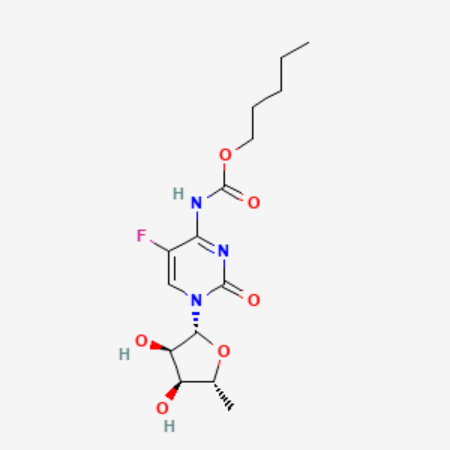
Capecitabine Chemical Structure
IUPAC (International Union of Pure and Applied Chemistry)/ Chemical name
pentyl N-[1-[(2R,3R,4S,5R)-3,4-dihydroxy-5-methyloxolan-2-yl]-5-fluoro-2-oxopyrimidin-4-yl]carbamate
Intake routine/cycle
Daily dose
Take Capecitabine exactly as your doctor recommends. The dose may change based on your condition and how well you respond. Do not take more than prescribed without consulting your doctor.
Missed Dose
If you forget to take your medicine, take the medication as soon as you remember. If it’s nearly time for your next dose, skip the missed one and continue with your regular schedule. Always consult the doctor before making any changes to your dosage.
Overdose
Capecitabine should not exceed 3500 mg per day as this medicine may cause diarrhea, mucositis, bone marrow suppression, and neurotoxicity. Immediate medical support is needed in case of any emergency.
Storage
- Store the medicine at room temperature
- Keep away from sunlight and moisture
- Keep out of reach of children
Capecitabine Summary
Capecitabine is an anti-cancer drug comes under anti metabolite category; this medicine It works by slowing the growth of cancer cells through the action of 5-fluorouracil, which blocks DNA and RNA production in cancer cells. This helps reduce cancer in different parts of the body. Common side effects include Diarrhea, Vomiting, Nausea, Loss of fingerprints and Stomach pain. Capecitabine should not exceed 3500 mg per day. Avoid alcohol, grape juice and grapefruit while taking this medicine
FAQ’s
What are the uses of capecitabine?
Capecitabine it is an anti-cancer drug, used to treat different types of cancers like Breast cancer, Colorectal cancer, Colon cancer, gastric, esophageal, or gastroesophageal junction cancer and Pancreatic cancer.
What is the price of capecitabine 500 mg tablet?
Capecitabine 500 mg price at SayaCare is about 430 rupees, at SayaCare we provide test report with each medicine. Also, at SayaCare we provide you with up to 80% less cost than the market.
What is the mechanism of action of capecitabine?
It works by slowing the growth of cancer cells through the action of 5-fluorouracil, which blocks DNA and RNA production in cancer cells. This helps reduce cancer in different parts of the body.
Reference
- Capecitabine (Oral Route) Description and Brand Names – Mayo Clinic [Internet]. www.mayoclinic.org. Available from
- Capecitabine [Internet]. go.drugbank.com. Available from
- National Cancer Institute. Side Effects of Cancer Treatment [Internet]. National Cancer Institute. Cancer.gov; 2024. Available from
- PubChem. Capecitabine (Xeloda) [Internet]. Nih.gov. PubChem; 2025 [cited 2025 Jul 11]. Available from
- Baxley A, Zheng C. Xeloda (Capecitabine): Uses, Side Effects, FAQs & More [Internet]. GoodRx. 2022 [cited 2025 Jul 11]. Available from
- Capecitabine (Xeloda) | Cancer information | Cancer Research UK [Internet]. www.cancerresearchuk.org. Available from
Authors


Pranathi is a final year Pharm D student at Chalapathi Institute of Pharmaceutical Sciences. She loves learning and applying her knowledge in pharmacy and has a passion for writing, which allows her to express ideas clearly and creatively. She enjoys combining her technical skills with her love for writing and communication to make a meaningful impact. Currently she is working on a research paper about “Consanguineous marriages and its impact on children’s health” which will be published by the end of 2025.