Category- Allopathy
Medicine Highlights
| Uses | 1. To reduce bad cholesterol levels in body 2. To control triglycerides in body |
| Common Side Effects | 1. Chills 2. Fever 3. Itching, skin rash 4. Muscle aches and pains 5. Nausea 6. Stomach pain 7. Vomiting 8. Runny nose, sneezing; or 9. Abnormal laboratory tests. |
| Additional Information | 1. To be taken only when prescribed by the doctor. Don’t use it without a doctor’s recommendation. |
| Storage | 1. The medicine should be stored at room temperature. 2. Keep away from sunlight and moisture. 3. Keep away from the reach of children |
| How to Take This Medicine | Take this medicine orally with a sip of water |
Fenofibrate Uses
Fenofibrate 145 mg is an oral medicine belonging to the category of lipid-lowering drugs and is used for the following indications:
- Controlling cholesterol level’s
- Reducing triglycerides in body
Fenofibrate side effects
More Common
- Chills
- Fever
- Itching, skin rash
- Muscle aches and pains
- Nausea
- Stomach pain
- Vomiting
- Runny nose, sneezing; or
- Abnormal laboratory tests.
Less Common
- Sharp stomach pain spreading to your back or shoulder blade
- Loss of appetite, stomach pain just after eating a meal
- Jaundice (yellowing of the skin or eyes)
- Fever, chills, weakness, sore throat, mouth sores, unusual bruising or bleeding
- Chest pain, sudden cough, wheezing, rapid breathing, coughing up blood
- Swelling, warmth, or redness in an arm or leg
How Fenofibrate works
Think of blood as a highway: cholesterol and triglycerides are the traffic, and when it jams, the risk of heart disease and stroke rises. Fenofibrate acts like a traffic cop who switches on a fat-controlling signal called PPAR-alpha inside the liver, which clears excess fats by speeding up their breakdown and removal. This leads to smoother blood flow and healthier arteries. It also improves levels of good fats while lowering bad ones. So, fenofibrate doesn’t just treat fat but it trains your body to manage fat better, keeping your heart’s highways running smoothly
Safety Measures and Warning
Breastfeeding
It is not known if fenofibrate passes into breast milk. Tell your health care provider if you are breastfeeding or plan to breastfeed. Your health care provider will let you know if you should stop breastfeeding or stop fenofibrate.
Pregnancy
Fenofibrate may cause harm to a developing fetus, especially if taken during the early stages of pregnancy. Animal studies have shown problems like delayed growth, skeletal changes, and even pregnancy loss. While there’s limited data in humans, doctors avoid prescribing it unless absolutely necessary. Get a recommendation from a doctor in case it’s necessary.
Fenofibrate Interaction with Food Product
Fenofibrate is generally safe with food, and it is recommended to avoid alcohol and smoking with fenofibrate, as they can alter the drug’s effect and may cause severe drowsiness and sedation because of their direct action on the brain.
Fenofibrate Interaction with Other Medicines
Avoid taking fenofibrate 145 mg with the following medicines, as it may increase or decrease the desired effect, or in worse cases, it could be fatal:
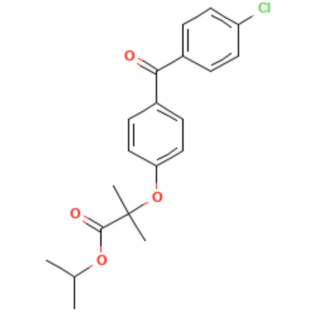
Fenofibrate Chemical Structure
IUPAC (International Union of Pure and Applied Chemistry)/ Chemical name
2-[4-(4-chlorobenzoyl) phenoxy] -2-methylpropanoic acid isopropyl ester
Intake routine/cycle
Daily dose
Take Fenofibrate exactly as your doctor recommends. The dose may change based on your condition and how well you respond. Do not take more than prescribed without consulting your doctor.
Missed Dose
If you forget to take your medicine, take the medication as soon as you remember. If it’s nearly time for your next dose, skip the missed one and continue with your regular schedule. Always consult the doctor before making any changes to your dosage.
Overdose
It is not recommended to take more than 200 mg of fenofibrate per day, as it may cause severe overdosing effects like liver damage, kidney damage, pancreatitis, and muscle problems. If you face any of the severe effects, take him to the doctor.
Storage
- Store the medicine at room temperature
- Keep away from sunlight and moisture
- Keep out of reach of children
Directions for use
- Take Fenofibrate exactly as prescribed by your doctor, at the same time each day.
- Do not stop taking Fenofibrate without your doctor’s approval, even if you feel better.
- If you forget to take Fenofibrate, take it as soon as you remember. If it’s almost time for your next dose, skip the missed dose.
Fenofibrate Summary
Fenofibrate is a lipid-lowering medicine in the fibrate class, mainly used to treat high cholesterol and triglycerides. It works by activating specific proteins (PPAR-alpha) that boost fat breakdown and reduce harmful blood fats. This helps lower risks linked to heart disease. Common side effects include stomach upset, muscle pain, and mild headaches. People with liver, kidney, or gallbladder disease, or those allergic to fibrates, should avoid it. fenofibrate interacts with stains leading to muscle damage. Muscle damage is only observed in few people. It can also affect blood thinners like warfarin, so dose adjustments may be needed. Always discuss with your doctor before starting or combining medications. Vulnerable populations for fenofibrate include elderly patients and those with renal or hepatic impairment, and overdose occurs at doses higher than 200 mg and may cause overdosing effects like liver and kidney problems and pancreatitis.
FAQ’s
What are the brand names of fenofibrate tablets?
Lipofen, Fenoglide, Antara, TriCor, and Triglide are the most famous brand names of fenofibrate used for reducing cholesterol in the body. Although there are many brands, the quality of medication is not always perfectly assured. Saya Care addresses this by providing tested reports to guarantee quality for each medication while offering prices up to 80% lower than marketed products.
What are the uses of fenofibrate tablets?
Fenofibrate is a lipid-lowering medicine in the fibrate class, mainly used to treat high cholesterol and triglycerides. This helps to lower risks linked to heart disease.
What is the maximum dose of fenofibrate per day?
It is not recommended to take more than 300 mg of fenofibrate per day, as it may cause severe overdosing effects like liver damage, kidney damage, pancreatitis, and muscle problems. If you face any of the severe effects, take him to the doctor.
What is the drug class of fenofibrate medication?
Fenofibrate belongs to the class of lipid-lowering agents and belongs to the subclass of fibrates.
Reference
- Drugs.com. Fenofibrate [Internet]. Drugs.com; 2024 [cited 2025 Jul 16]. Available from.
- WebMD. Fenofibrate oral: Uses, side effects, interactions and more [Internet]. WebMD; 2025 [cited 2025 Jul 16]. Available from.
- National Center for Biotechnology Information. Fenofibrate [Internet]. In: LiverTox: Clinical and Research Information on Drug-Induced Liver Injury. Bethesda (MD): National Institute of Diabetes and Digestive and Kidney Diseases; 2012 [cited 2025 Jul 16]. Available from.
- Mayo Clinic. Fenofibrate (Oral Route) Description and Brand Names [Internet]. Mayo Foundation for Medical Education and Research; 2024 [cited 2025 Jul 16]. Available from.
- National Center for Biotechnology Information. PubChem Compound Summary for CID 3339, Fenofibrate [Internet]. PubChem; 2004 [cited 2025 Jul 16]. Available from.
Authors



Siva Krishna Adithya Bhumireddy completed a Bachelor of Pharmacy from GIET School of Pharmacy, affiliated with Andhra University, and from his 3rd year of graduation, he was working as a freelance medical and publication writer. Having expertise in systematic reviews and clinical research. With his keen interest and skills in research and documentation practices, he also reviewed more than 150 manuscripts from international journals like Elsevier, Springer Nature, and Sage Journals, and all the manuscripts were indexed and appeared in PubMed, Scopus, and Web of Science databases, and he received honorary recognition letters and certificates from all of them. Siva Krishna Adithya also published a few systematic, narrative reviews and a few chapters of international expertise.