Category- Allopathy
Medicine Highlights
| Uses | 1. Treats severe lung infections (pneumonia) 2. Treats blood infections (sepsis) 3. Treats endocarditis 4. Treats skin and soft-tissue infections 5. Treats bone and joint infections |
| Common Side Effects | 1. Nausea or vomiting 2. Stomach upset 3. Headache 4. Redness or pain at injection site 5. Skin rash or itching 6. Flushing of face/neck (red man syndrome) 7. Mild dizziness |
| Additional Information | To be taken only when prescribed by the doctor. |
| Storage | 1. The medicine should be stored at room temperature. 2. Keep away from sunlight and moisture. 3. Keep away from the reach of children |
| How to Take This Medicine | This medication is given through an injection by a doctor or nurse. |
Vancomycin Uses
Vancomycin is an oral medicine belonging to the category of antibiotics and is used to treat following infections:
- Severe lung infections (pneumonia)
- Blood infections (sepsis)
- Heart valve infection (endocarditis)
- Skin and soft-tissue infections
- Bone and joint infections
Directions for use
- Take this medicine exactly as prescribed by your doctor, consistently at the same time each day.
- Do not stop taking this medicine without your doctor’s approval, even if you feel better.
- If you miss a dose, take it as soon as you remember, unless it’s close to your next dose; then skip the missed one.
Vancomycin side effects
More Common
- Nausea or vomiting
- Stomach upset
- Headache
- Redness or pain at injection site
- Skin rash or itching
- Flushing of face/neck (red man syndrome)
- Mild dizziness
Less common
- Black, tarry stools
- Bleeding gums
- Blood in the urine or stools
- Continuing ringing or buzzing or other unexplained noise in the ears
- Cough or hoarseness
- Dizziness, faintness, or lightheadedness when getting up suddenly from a lying or sitting position
- Feeling of constant movement of self or surroundings
- Feeling of fullness in the ears
- Fever with or without chills
- General feeling of tiredness or weakness
- Hearing loss
- Large blisters on the arms, legs, hands, feet, or upper body
- Loss of balance
- Lower back or side pain
- Painful or difficult urination
- Pale skin
- Pinpoint red spots on the skin
- Ringing or buzzing in the ears
- Sensation of spinning
- Sore throat
- Sores, ulcers, or white spots on the lips or in the mouth
- Sweating
- Trouble in hearing
- Unusual bleeding or bruising
- Unusual tiredness or weakness
How Vancomycin works
Vancomycin kills bacteria by stopping them from making their protective cell walls. Without this wall, the bacteria break down and die, which helps cure the infection.
Safety Measures and Warning
Allergy/Hypersensitivity
If you are allergic to this medicine, inform your doctor, as it may cause serious allergic reactions such as rash, itching, swelling of the face or lips, or breathing difficulty.
Hearing or balance problems
Tell your doctor if you have hearing issues, as vancomycin may rarely affect hearing.
Kidney problems
Inform your doctor if you have kidney disease, because this medicine is removed through the kidneys and may worsen kidney function.
Pregnancy
If you are pregnant, inform your doctor, as this medicine may harm the unborn baby and affect bone and tooth development.
Breastfeeding
If you are breastfeeding, tell your doctor, as this medicine can pass into breast milk and may affect the baby.
Vancomycin Interaction with other Medicines
Avoid taking Vancomycin with the following medicines, as it may increase or decrease the desired effect, or in worse cases, it could be fatal:
Vancomycin Interaction with Food Products
Vancomycin has no major food interactions. Normal meals do not affect the injection form, and oral vancomycin can be taken with or without food, though taking it with food may help prevent stomach upset. Drink enough fluids unless your doctor advises otherwise.
Storage
- The medicine should be stored at room temperature.
- Keep away from sunlight and moisture.
- Keep away from the reach of children.
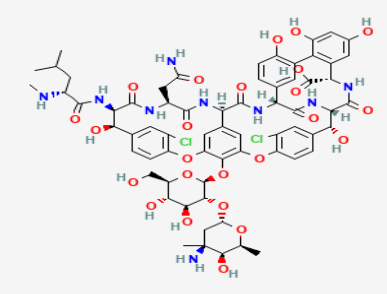
Vancomycin Chemical Structure
IUPAC (International Union of Pure and Applied Chemistry)/ Chemical name
Vancomycin: (1S,2R,18R,19R,22S,25R,28R,40S)-48-[(2S,3R,4S,5S,6R)-3-[(2S,4S,5S,6S)-4-amino-5-hydroxy-4,6-dimethyloxan-2-yl]oxy-4,5-dihydroxy-6-(hydroxymethyl)oxan-2-yl]oxy-22-(2-amino-2-oxoethyl)-5,15-dichloro-2,18,32,35,37-pentahydroxy-19-[[(2R)-4-methyl-2-(methylamino)pentanoyl]amino]-20,23,26,42,44-pentaoxo-7,13-dioxa-21,24,27,41,43-pentazaoctacyclo[26.14.2.23,6.214,17.18,12.129,33.010,25.034,39]pentaconta-3,5,8(48),9,11,14,16,29(45),30,32,34(39),35,37,46,49-pentadecaene-40-carboxylic acid
Intake routine/cycle
Daily Dose
Take Vancomycin exactly as your doctor recommends. The dose may change based on your condition and how well you respond. Do not take more than prescribed without consulting your doctor.
Missed Dose
If you forget to take your medicine, take the medication as soon as you remember. If it’s nearly time for your next dose, skip the missed one and continue with your regular schedule. Always consult the doctor before making any changes to your dosage.
Overdose
Don’t take more than 2g/per day of vancomycin, Symptoms of an overdose include seizures, breathlessness, high blood pressure, and liver dysfunction. If you know someone who takes this medicine and has these symptoms, then rush them to the hospital immediately.
Vancomycin Summary
Vancomycin 500 mg is a strong antibiotic used to treat serious bacterial infections in lung, blood, skin and soft-tissue, bone and joint, heart valve, and certain severe gut. It works by stopping bacteria from forming their protective cell wall, which makes the bacteria weak and causes them to die. It is usually given by injection in hospitals (sometimes taken by mouth for gut infections) and has no major food interactions. Common side effects include nausea, vomiting, rash, itching, injection-site pain, dizziness, and flushing of the face and neck (red man syndrome if given too fast). It may also affect the kidneys or hearing in some people.
Vancomycin should not be used in patients allergic to it and must be used carefully in those with kidney problems or hearing issues. Pregnant and breastfeeding women should take it only if prescribed by a doctor, and treatment should always be done under medical supervision.
FAQ’s
What drug class does Vancomycin belong to?
Vancomycin belongs to a group of antibiotics called glycopeptide antibiotics, which are used to treat serious bacterial infections.
What are the common side effects of Vancomycin?
Common side effects include nausea, vomiting, headache, skin rash or itching, redness or pain at the injection site, flushing of the face and neck (red man syndrome), dizziness, and stomach upset. In some people, it may also affect the kidneys or hearing, so tell your doctor if you notice reduced urine or ringing in the ears.
What is the mechanism of action of Vancomycin?
Vancomycin works by stopping bacteria from making their protective cell wall. Without this wall, the bacteria become weak and die, helping clear the infection.
What is Red Man Syndrome with Vancomycin?
Red Man Syndrome is a reaction that can happen when vancomycin is given too fast through injection. It causes redness or flushing of the face, neck, and upper body, itching, and sometimes low blood pressure. It is not a true allergy and usually improves when the infusion is slowed or stopped.
Who should not take Vancomycin?
Vancomycin should not be used in people who are allergic to vancomycin. It should also be used with caution in patients with kidney problems or hearing issues, and during pregnancy or breastfeeding, only if prescribed by a doctor.
Reference
- Mayo Clinic. Vancomycin (Intravenous Route) Description and Brand Names – Mayo Clinic [Internet]. Mayoclinic.org. 2019. Available from
- PubChem. Vancomycin [Internet]. pubchem.ncbi.nlm.nih.gov. Available from
- Patel S, Preuss CV, Bernice F. Vancomycin [Internet]. National Library of Medicine. StatPearls Publishing; 2024. Available from
- Medscape. Vancocin (vancomycin) dosing, indications, interactions, adverse effects, and more [Internet]. Medscape.com. 2019. Available from
Authors


Pranathi is a final year Pharm D student at Chalapathi Institute of Pharmaceutical Sciences. She loves learning and applying her knowledge in pharmacy and has a passion for writing, which allows her to express ideas clearly and creatively. She enjoys combining her technical skills with her love for writing and communication to make a meaningful impact. Currently she is working on a research paper about “Consanguineous marriages and its impact on children’s health” which will be published by the end of 2025.