Category- Allopathy
Medicine Highlights
| Uses | 1. To treat athlete’s foot (interdigital tinea pedis) 2. To treat Jock itch (Tinea cruris) 3. To treat Ringworm of body (Tinea Corporis) 4. To treat fungal infections in skin folds and underarms (yeast infections) |
| Common Side Effects | 1. Mild stinging or burning 2. Itching or tingly feeling 3. Skin dryness, peeling, or flaking 4. Redness or other irritation. |
| Additional Information | 1. To be used for external application only 2. Wash hands after application to avoid accidental contact with eyes or mouth. |
| Storage | 1. The medicine should be stored at room temperature. 2. Keep away from sunlight and moisture. 3. Keep away from the reach of children |
| How to Take This Medicine | The medicine should be applied to the affected area. |
Amorolfine Uses
Amorolfine 0.25% is a topical cream belonging to the class of antifungal creams and used for various types of fungal infections caused by different fungi including
- Athlete’s foot (tinea Pedis)
- Jock itch (tinea cruris)
- Ringworm of the Body (tinea Corporis)
- Nail and skin fungal infections.
Amorolfine side effects
More Common
- Mild stinging or burning
- Itching or tingly feeling
- Skin dryness, peeling, or flaking
- Redness or other irritation.
Less Common
- Blistering, crusting, dryness, or flaking of the skin
- Itching, pain, tenderness, or warmth on the skin
- Scaling, severe redness, soreness, or swelling of the skin.
How Amorolfine works
Amorolfine works by blocking the fungus’s ability to make ergosterol, a key chemical necessary for the fungus to build its skin. But this cream stops the release of ergosterol, leading to the weakening of fungus walls, so the fungus collapses and dies, which helps clear skin infections like athlete’s foot, jock itch, and ringworm.
Safety Measures and Warning
Pregnancy
It is considered safe to use during pregnancy.
Allergies
If you have previously had an allergy to this medicine, inform your doctor.
Broken or Damaged Skin
Avoid applying it to open wounds, ulcers, or severely damaged skin because it can increase systemic absorption of steroids.
Breastfeeding
It is safe to use while breastfeeding.
Amorolfine Interaction with Food Product
Amorolfine does not interact with food products, as it can be applied on the skin only. So, it is safe to use without any fear of food interactions.
Amorolfine Interaction with Other Medicines
Avoid taking Amorolfine with the following medicines, as it may increase or decrease the desired effect, or in worse cases, it could be fatal:
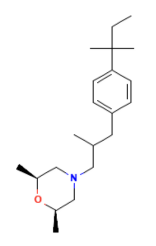
Amorolfine Chemical Structure
IUPAC (International Union of Pure and Applied Chemistry)/ Chemical name
(2S,6R)-2,6-dimethyl-4-[2-methyl-3-[4-(2-methylbutan-2-yl)phenyl]propyl]morpholine
Intake routine/cycle
Daily dose
Take Amorolfine exactly as your doctor recommends. The dose may change based on your condition and how well you respond. Do not take more than prescribed without consulting your doctor.
Missed Dose
If you forget to take your medicine, take the medication as soon as you remember. If it’s nearly time for your next dose, skip the missed one and continue with your regular schedule. Always consult the doctor before making any changes to your dosage.
Overdose
Apply Amorolfine suspension/cream as per doctor’s instructions; do not consume orally. If ingested orally by mistake, overdose symptoms may occur and include nausea, irritation, and vomiting; excessive skin application causes marks on skin and burning sensations.
Storage
- Store the medicine at room temperature.
- Keep away from sunlight and moisture.
- Keep out of reach of children.
Directions for use
- Do not apply in the eye
- Make sure to apply evenly on the skin
- Do not stop using this medicated cream immediately unless allergic; complete the full course.
Amorolfine Summary
Amorolfine 0.25% cream is a topical antifungal medicine used to treat fungal infections in nails and skin, like athlete’s foot, ringworm, and jock itch. It belongs to the morpholine antifungal drug class and works by blocking ergosterol production in fungal cell membranes, which kills the fungus. Common side effects of this medication are mild redness, itching, burning, or irritation at the site of application. This medicine does not interact with food since it is applied on the skin, but people with allergies to amorolfine or severe skin damage should avoid it. Overdose is rare, but applying large amounts can cause excessive local irritation or, in very rare cases, systemic effects.
FAQ’s
What does Amorolfine do to skin?
Amorolfine attacks the fungus on the skin by blocking its ability to build a strong protective wall. This weakens and kills the fungus, helping clear infections like athlete’s foot, jock itch, and ringworm.
What are the side effects of Amorolfine cream?
Amorolfine is usually well tolerated, but it can sometimes cause mild skin reactions like redness, itching, burning, or dryness where it’s applied. These effects are generally short‑lived and settle on their own.
Can Amorolfine be applied on private parts?
Yes, Amorolfine cream can be applied to the groin or private parts if prescribed for fungal infections like jock itch. It should only be used externally on the skin, never inside the vagina, urethra, or rectum.
Is Amorolfine a steroid?
No, Amorolfine is not a steroid; it is an antifungal medicine from the azole class. It treats fungal skin infections by weakening the fungus’s protective wall, not by reducing inflammation like steroids do.
Reference
- Patel P, Zito PM. Antifungal Agents. [Updated 2025 Jul 6]. In: StatPearls [Internet]. Treasure Island (FL): StatPearls Publishing; 2025 Jan. Available from.
- PubChem [Internet]. Bethesda (MD): National Library of Medicine (US), National Center for Biotechnology Information; 2004-. PubChem Compound Summary for CID 4189, Amorolfine; [cited 2026 Feb. 12]. Available from.
- Synapse Patsnap. What are the side effects of amorolfine hydrochloride. [Internet]. Synapse; 2025 [cited 2026 Feb 16]. Available from.
- Haria M, Bryson HM. Amorolfine. A review of its pharmacological properties and therapeutic potential in the treatment of onychomycosis and other superficial fungal infections. Drugs. 1995 Jan;49(1):103-20.Available from.
Authors



Siva Krishna Adithya Bhumireddy completed a Bachelor of Pharmacy from GIET School of Pharmacy, affiliated with Andhra University, and from his 3rd year of graduation, he was working as a freelance medical and publication writer. Having expertise in systematic reviews and clinical research. With his keen interest and skills in research and documentation practices, he also reviewed more than 150 manuscripts from international journals like Elsevier, Springer Nature, and Sage Journals, and all the manuscripts were indexed and appeared in PubMed, Scopus, and Web of Science databases, and he received honorary recognition letters and certificates from all of them. Siva Krishna Adithya also published a few systematic, narrative reviews and a few chapters of international expertise.