Category- Allopathy
Medicine Highlights
| Uses | 1. To treat scabies and papules in underarms, genitals, fingers, etc. 2. To control other bacterial and fungal infections |
| Common Side Effects | 1. Itching or rash of the skin and scalp 2. Redness of the skin 3. Tingling and numbness of skin 4. Burning or stinging sensation 5. Skin rash |
| Additional Information | 1. To be used for external application only 2. Use only when recommended by the doctor |
| Storage | 1. The medicine should be stored at room temperature 2. Keep away from sunlight and moisture 3. Keep away from the reach of children |
| How to Take This Medicine | 1. This is a medicated soap and should be applied to the body. |
Monosulfiram Uses
Monosulfiram 5% is a topical soap belonging to the class of anti-parasite soaps and used for maintaining hygiene and killing different parasites like scabies mites and head lice.
Monosulfiram side effects
More Common
- Itching or rash of the skin and scalp
- Redness of the skin
- Tingling and numbness of skin
- Burning or stinging sensation
- Skin rash
Less Common
- Infected and pus-filled areas on the skin and scalp
How Monosulfiram works
Monosulfiram works by attacking tiny insects like scabies mites or head lice that cause itching and skin problems. When you use Monosulfiram soap, it enters the body of these bugs and blocks their nerve signals, making them freeze and die, just like cutting the wires of a machine.
Safety Measures and Warning
Pregnancy
It is considered safe to use during pregnancy.
Allergy or Hypersensitivity
If you have previously had an allergy to this medicine, inform your doctor.
Breastfeeding
It is safe to use while breastfeeding.
Monosulfiram Interaction with Food Product
Monosulfiram does not interact with food products, as it can be applied on the skin only. So, it is safe to use without any fear of food interactions.
Monosulfiram Interaction with Other Medicines
Avoid taking Monosulfiram 5% with the following medicines, as it may increase or decrease the desired effect, or in worse cases, it could be fatal:
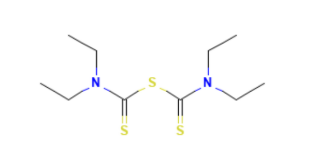
Monosulfiram Chemical Structure
IUPAC (International Union of Pure and Applied Chemistry)/ Chemical name
diethylcarbamothioyl N,N-diethylcarbamodithioate
Intake routine/cycle
Daily dose
Take Monosulfiram exactly as your doctor recommends. The dose may change based on your condition and how well you respond. Do not take more than prescribed without consulting your doctor.
Missed Dose
If you forget to take your medicine, take the medication as soon as you remember. If it’s nearly time for your next dose, skip the missed one and continue with your regular schedule. Always consult the doctor before making any changes to your dosage.
Overdose
Use Monosulfiram soap as per the doctor’s instructions; do not consume orally. If ingested orally by mistake, overdose symptoms may occur and include nausea, irritations, and vomiting; excessive skin application causes marks on skin and burning sensations.
Storage
- Store the medicine at room temperature.
- Keep away from sunlight and moisture.
- Keep out of reach of children.
Directions for use
- Do not apply to the eyes. If accidental contact occurs, rinse thoroughly with clean water.
- Make sure to form lather before use
- Do not stop using it suddenly; complete the full course unless you are allergic.
Monosulfiram Summary
Monosulfiram soap is a medicated cleanser used to treat scabies and head lice by killing the tiny parasites that burrow into skin or cling to hair. It works like a nerve disruptor for these bugs, paralyzing them by blocking their ability to send signals, which leads to their death. People usually apply it to the whole body or scalp, leave it on for a short time, then rinse it off. While it’s generally safe, some may feel mild itching, redness, or dryness after use. Babies under 2 months, those with severe skin allergies, or people with known sensitivity to Monosulfiram should avoid it.
FAQ’s
Will Monosulfiram kill lice eggs?
Monosulfiram kills lice but may not destroy all their eggs (nits), so some can hatch later and cause re-infestation. That’s why doctors often suggest using it again after a few days and combing the eggs to fully clear the problem.
What are the uses of Monosulfiram -medicated soap?
Monosulfiram medicated soap is used to treat scabies and head lice by killing the tiny insects that cause itching and skin irritation. It works by paralyzing these pests, making it easier to wash them away and stop the spread.
What is the mechanism of action of Monosulfiram?
Monosulfiram works by binding to sodium channels in the nerves of lice and mites, keeping them open and causing uncontrolled nerve signals. This leads to paralysis and death of the parasites while remaining safe for human skin.
How to tell if Monosulfiram is working?
You’ll know Monosulfiram is working when the itching slowly reduces and no new rashes or bumps appear after a few days. Some itching may still continue for weeks, but if symptoms don’t worsen or spread, the treatment is doing its job.
How dangerous is Monosulfiram to your skin?
Monosulfiram is generally safe for human skin when used as directed, but it can cause mild side effects like itching, redness, or a burning feeling where applied. These reactions usually fade on their own, but people with sensitive skin or allergies should talk to a doctor before using it to avoid irritation
Reference
- MedicinesFAQ. Monosulfiram: Uses, Dosage, Side Effects, Food Interaction & FAQ [Internet]. Medicines FAQ; 2025 Jan 7 [cited 2026 Mar 6]. Available from.
- MedEx. Monosulfiram: Indications, Pharmacology, Dosage, Side Effects & Generic Info [Internet]. MedEx; [cited 2026 Mar 6]. Available from.
- Health Encyclopedia. Monosulfiram [Internet]. Health Encyclopedia; [cited 2026 Mar 6]. Available from.
- PubChem [Internet]. Bethesda (MD): National Library of Medicine (US), National Center for Biotechnology Information; 2004-. PubChem Compound Summary for CID 7215, Sulfiram; [cited 2026 Mar. 6]. Available from.
Authors



Siva Krishna Adithya Bhumireddy completed a Bachelor of Pharmacy from GIET School of Pharmacy, affiliated with Andhra University, and from his 3rd year of graduation, he was working as a freelance medical and publication writer. Having expertise in systematic reviews and clinical research. With his keen interest and skills in research and documentation practices, he also reviewed more than 150 manuscripts from international journals like Elsevier, Springer Nature, and Sage Journals, and all the manuscripts were indexed and appeared in PubMed, Scopus, and Web of Science databases, and he received honorary recognition letters and certificates from all of them. Siva Krishna Adithya also published a few systematic, narrative reviews and a few chapters of international expertise.