Category- Allopathy
Medicine Highlights
| Uses | 1. To treat high blood pressure in adults 2. To support control of cancer-related pains 3. To treat attention deficit hyperactivity disorder in children. 4. To improve coordination in Tourette syndrome |
| Common Side Effects | 1. Headache 2. Dizziness 3. Constipation 4. Skin rash 5. Decreased blood pressure 6. Nausea |
| Additional Information | 1. Take medicine every day at the same time to maintain the drug well in the blood. 2. Do not stop the medicine usage suddenly. 3. It is also used off-label for withdrawal symptoms in narcotics and psychotropics use, migraine, and restless leg syndrome. |
| Storage | 1. The medicine should be stored at room temperature. 2. Keep away from sunlight and moisture. 3. Keep away from the reach of children. |
| How to Take This Medicine | Take this medication orally with a sip of water. |
Clonidine Uses
Clonidine 0.1 mg is an oral medicine belonging to the category of centrally acting antihypertensives used to treat high blood pressure and chest pain.
Directions for use
- Take clonidine exactly as prescribed by your doctor, consistently at the same time each day.
- Do not stop taking clonidine without your doctor’s approval, even if you feel better.
- If you miss a dose, take it as soon as you remember, unless it’s close to your next dose then skip the missed one.
Clonidine side effects
More Common
- Headache
- Dizziness
- Constipation
- Skin rash
- Decreased blood pressure
- Nausea
Less common
- Swelling of the feet and lower legs
- Darkening of the skin
- Decreased sexual ability
- Dry, itching, or burning eyes
- Loss of appetite
- Nausea or vomiting
How Clonidine works
Clonidine works by calming down the “fight-or-flight” signals caused by adrenaline and dopamine in the body. It stimulates special switches in the brain called alpha-2 receptors, which reduce the release of stress chemicals like adrenaline. As a result, the heart slows a bit, blood pressure drops, and the body feels more relaxed
Safety Measures and Warning
Kidney and Liver Problems
Patients with kidney or liver problems are at higher risk of toxicity because the drug is processed in the liver and cleared by the kidneys. This can lead to harmful interactions, so medical advice is essential before using it. So, always consult a doctor before using it.
Pregnancy
Pregnant women are not recommended to take clonidine, as there are no human studies supporting its safety during pregnancy. In case of an emergency, consult a doctor before using it.
Breastfeeding
Clonidine can pass into breast milk, so it’s used with caution during breastfeeding. Other safer options are usually tried first. If clonidine is needed, the baby should be watched closely for any changes like diarrhea or sleepiness. Always talk to your doctor before using it.
Clonidine Interaction with other Medicines
Avoid taking clonidine with the following medicines, as it may increase or decrease the desired effect, or in worse cases, it could be fatal:
Clonidine Interaction with Food Products
Clonidine is generally safe with food, and it is recommended to avoid alcohol and smoking with clonidine, as they can alter the drug’s effect and may cause severe drowsiness and sedation because of their direct action on the brain.
Storage
- The medicine should be stored at room temperature.
- Keep away from sunlight and moisture.
- Keep away from the reach of children.
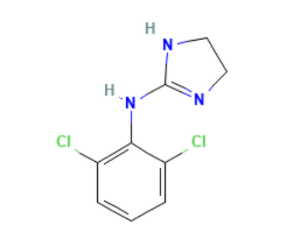
Clonidine Chemical Structure
IUPAC (International Union of Pure and Applied Chemistry)/ Chemical name
N-(2,6-dichlorophenyl)-4,5-dihydro-1H-imidazol-2-amine
Intake routine/cycle
Daily Dose
Take clonidine exactly as your doctor recommends. The dose may change based on your condition and how well you respond. Do not take more than prescribed without consulting your doctor.
Missed Dose
If you forget to take your medicine, take the medication as soon as you remember. If it’s nearly time for your next dose, skip the missed one and continue with your regular schedule. Always consult the doctor before making any changes to your dosage.
Overdose
It is not recommended to take more than 30 mg of clonidine per day, as it may cause severe adverse effects like extreme drowsiness, confusion, low blood pressure, unconsciousness, high fever, severe diarrhea, and heart weakness.
Clonidine Summary
Clonidine 0.1 mg is an FDA‑approved medicine that lowers blood pressure by calming overactive nerves in the brain, slowing the heart, and reducing pressure. It is mainly used for hypertension, ADHD in children, certain cancer‑related pain, and easing withdrawal from opioids or alcohol. This makes it both a blood‑pressure controlling and calming agent. Common side effects include sleepiness, dry mouth, dizziness, constipation, low blood pressure, and slow heartbeat. It can interact with other blood pressure medicines, sleeping pills, antidepressants, alcohol, and grapefruit juice, which may increase drowsiness or lower blood pressure. People with a slow heart rate, kidney and liver problems, an allergy to clonidine, and depression should avoid this medicine. Taking more than 1 mg of clonidine can cause dangerously low blood pressure, very slow or irregular heartbeat, deep sleepiness, trouble breathing, or a coma, so any suspected overdose needs immediate emergency care, and the drug should never be stopped suddenly without a doctor’s advice.
FAQ’s
What is the mechanism of action of clonidine?
Clonidine works by stimulating alpha-2 receptors in the brain, which reduces the release of stress chemicals like adrenaline. This calming effect lowers blood pressure and slows the heart rate by relaxing blood vessels.
What are the uses of clonidine tablets?
Clonidine tablets are mainly used to treat high blood pressure, ADHD (in children and adults), and to ease withdrawal symptoms from opioids, alcohol, or nicotine. They are also sometimes prescribed for migraine prevention, menopausal hot flashes, and certain pain conditions.
What are the side effects of clonidine tablets?
Common side effects of clonidine use include headaches, dizziness, swollen ankles, and sometimes tummy discomfort or skin rashes.
Reference
- Patel P, Saadabadi A. Clonidine. [Updated 2025 Dec 13]. In: StatPearls [Internet]. Treasure Island (FL): StatPearls Publishing; 2025 Jan-. Available from.
- PubChem [Internet]. Bethesda (MD): National Library of Medicine (US), National Center for Biotechnology Information; 2004-. PubChem Compound Summary for CID 2803, Clonidine; [cited 2026 Feb. 4]. Available from.
- Mayo Clinic. Clonidine (oral route) – Side effects & dosage. Mayo Clinic [Internet]. 2026 Jan 1 [cited 2026 Feb 4]. Available from.
- Drugs.com. Clonidine: Uses, Dosage, Side Effects, Warnings. Drugs.com [Internet]. 2025 Oct 29 [cited 2026 Feb 4]. Available from.
Authors



Siva Krishna Adithya Bhumireddy completed a Bachelor of Pharmacy from GIET School of Pharmacy, affiliated with Andhra University, and from his 3rd year of graduation, he was working as a freelance medical and publication writer. Having expertise in systematic reviews and clinical research. With his keen interest and skills in research and documentation practices, he also reviewed more than 150 manuscripts from international journals like Elsevier, Springer Nature, and Sage Journals, and all the manuscripts were indexed and appeared in PubMed, Scopus, and Web of Science databases, and he received honorary recognition letters and certificates from all of them. Siva Krishna Adithya also published a few systematic, narrative reviews and a few chapters of international expertise.