Category- Allopathy
Medicine Highlights
| Uses | 1. To treat high blood pressure 2. To treat Angina pectoris 3. To prevent myocardial infarction |
| Common Side Effects | 1. Blurred vision 2. Chest tightness 3. Cold hands or feet 4. Confusion 5. Difficult or labored breathing |
| Additional Information | Avoid taking alcohol or tobacco with this medicine. |
| Storage | 1. The medicine should be stored at room temperature 2. Keep away from sunlight and moisture 3. Keep away from the reach of children |
| How to Take This Medicine | Take this medication orally with a sip of water. |
Metoprolol Uses
Metoprolol 100 mg is an oral medicine belonging to the class of selective beta-blocker medicines. It is used for the following indications:
- High blood pressure (Hypertension)
- Chest pain (Angina pectoris)
- Heart attack (Myocardial infarction)
Directions for use
- Take metoprolol exactly as prescribed by your doctor, consistently at the same time each day.
- Do not stop taking metoprolol without your doctor’s approval, even if you feel better.
- If you miss a dose, take it as soon as you remember, unless it’s close to your next dose-then skip the missed one.
Metoprolol side effects
More Common
- Blurred vision
- Chest tightness
- Cold hands or feet
- Confusion
- Difficult or labored breathing
- Dizziness, faintness, or lightheadedness when getting up suddenly from a lying or sitting position
- Sweating
- Unusual tiredness or weakness
Less common
- Anxiety
- Chest pain or discomfort
- Chills
- Cold sweats
- Cough
- Dizziness or lightheadedness
- Fainting
- Fast heartbeat
- Leg pain
- Noisy breathing
- Slow or irregular heartbeat
How Metoprolol works
Metoprolol lowers blood pressure by blocking a receptor in blood vessels called the beta-1 receptor. By blocking this receptor, chemicals like norepinephrine, epinephrine, and isoproterenol, which cause blood vessel contraction and increase blood pressure, are unable to bind to it. Additionally, by blocking beta-1 receptors in the heart, metoprolol reduces heart rate and the force of heart contractions, further helping to lower blood pressure.
Safety Measures and Warning
Allergies/Hypersensitivity
If you are allergic to this medicine, then inform your doctor immediately.
Pregnancy
Metoprolol crosses the placenta and can cause fetal abnormalities if taken during pregnancy, so if you are pregnant or planning to conceive, inform your doctor about it.
Breastfeeding
Metoprolol passes into breast milk in small amounts and is generally considered safe during breastfeeding, with no major harmful effects reported in infants.
Metoprolol Interaction with other Medicines
Avoid taking metoprolol with the following medicines, as it may increase or decrease the desired effect, or in worse cases, it could be fatal:
Metoprolol Interaction with Food Products
Metoprolol does not interact with any food products, but alcohol should be avoided before and after taking the medicine, as it can increase or decrease the effect of metoprolol.
Storage
- The medicine should be stored at room temperature.
- Keep away from sunlight and moisture.
- Keep away from the reach of children
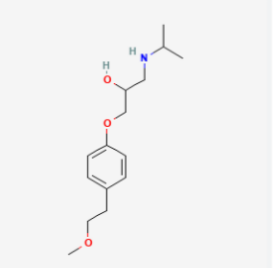
Metoprolol Chemical Structure
IUPAC (International Union of Pure and Applied Chemistry)/ Chemical name
1-[4-(2-methoxyethyl)phenoxy]-3-(propan-2-ylamino)propan-2-ol
Intake routine/cycle
Daily Dose
Take metoprolol exactly as your doctor recommends. The dose may change based on your condition and how well you respond. Do not take more than prescribed without consulting your doctor.
Missed Dose
If you forget to take your medicine, take the medication as soon as you remember. If it’s nearly time for your next dose, skip the missed one and continue with your regular schedule. Always consult the doctor before making any changes to your dosage.
Overdose
It is not recommended to take more than 1500 mg a day, as it can cause lower heart rate and slow breathing and can even cause life-threatening complications. If someone you know is taking this medicine and exhibits any of these symptoms, seek medical attention immediately.
Metoprolol Summary
Metoprolol is a cardioselective beta blocker. The FDA approved it for the treatment of high blood pressure, chest pain, and heart failure and for reducing death risk after heart attack. Off-label uses of this medicine include migraine prevention, fast heart rhythms, and anxiety. It works by blocking beta receptors in the heart, which slows heart rate and reduces strain. The common side effects of this medicine are tiredness, dizziness, slow heartbeat, depression, and stomach upset. It interacts with alcohol and foods and can lower blood pressure. People with very slow heart rates, severe heart blocks, shock, or uncontrolled heart failure should avoid it. Taking more than 1000 mg can cause dangerously slow heart rate, very low blood pressure, fainting, seizures, breathing problems, and cardiac arrest.
FAQ’s
When to take Metoprolol tablets?
Metoprolol usually causes dizziness, which is why doctors advise patients to take it before bedtime.
Can metoprolol cause bradycardia?
A study conducted to examine the effect of metoprolol on heart rate in both males and females found that women who consumed a high dose of metoprolol had a lower heart rate, but the same effect was not observed in men.
Will Metoprolol lower heart rate?
Yes, Metoprolol lowers heart rate by blocking adrenaline’s effects on the heart. It’s important to follow your doctor’s instructions and not stop it suddenly.
Reference
- NHS. Metoprolol: how and when to take it [Internet]. London: National Health Service; [cited 2024 Dec 20]. Available from.
- Hendriksen LC, Omes-Smit G, Koch BCP, Ikram MA, Stricker BH, Visser LE. Sex-Based Difference in the Effect of Metoprolol on Heart Rate and Bradycardia in a Population-Based Setting. J Pers Med. 2022 May 25;12(6):870.Available from.
- Drugs.com. Can metoprolol lower resting heart rate? [Internet]. [cited 2024 Dec 20]. Available from.
- Morris J, Awosika AO, Dunham A. Metoprolol. [Updated 2024 Feb 29]. In: StatPearls [Internet]. Treasure Island (FL): StatPearls Publishing; 2024 Jan-. Available from.
- Mayo Clinic. Metoprolol (Oral route) [Internet]. Rochester: Mayo Foundation for Medical Education and Research; [cited 2024 Dec 20]. Available from.
Authors



Siva Krishna Adithya Bhumireddy completed a Bachelor of Pharmacy from GIET School of Pharmacy, affiliated with Andhra University, and from his 3rd year of graduation, he was working as a freelance medical and publication writer. Having expertise in systematic reviews and clinical research. With his keen interest and skills in research and documentation practices, he also reviewed more than 150 manuscripts from international journals like Elsevier, Springer Nature, and Sage Journals, and all the manuscripts were indexed and appeared in PubMed, Scopus, and Web of Science databases, and he received honorary recognition letters and certificates from all of them. Siva Krishna Adithya also published a few systematic, narrative reviews and a few chapters of international expertise.