Category- Allopathy
Medicine Highlights
| Uses | 1. To abort pregnancies within 70 days of conceiving 2. To improve labor pains 3. To treat gastric ulcers caused by painkiller medicine |
| Common Side Effects | 1. Diarrhea 2. Stomach pain |
| Additional Information | 1. Use this medicine under strict medical guidance only. 2. Its off-label indications include prevention of bleeding after giving birth and labor pain improvement. |
| Storage | 1. The medicine should be stored at room temperature. 2. Keep away from sunlight and moisture. 3. Keep away from the reach of children |
| How to Take This Medicine | Take this medicine orally with a sip of water |
Misoprostol Uses
Misoprostol 250 mcg is an oral medicine belonging to the category of prostaglandin analogues and is used for the following indications:
- Gastric ulcers caused by painkillers.
- Abort pregnancies within 70 days of conceiving
- Used to induce labor pains in few cases
Misoprostol side effects
More Common
- Diarrhea
- Stomach pain
Less Common
- Acid or sour stomach
- Belching
- Bloated
- Excess air or gas in the stomach or intestines
- Full feeling
- Heartburn
- Indigestion
- Passing gas
- Stomach discomfort or upset
How Misoprostol works
Misoprostol is a medicine that helps in two main ways. For people who take strong painkillers like ibuprofen or aspirin, it protects the stomach by making more natural juices that coat and shield the stomach lining, lowering the chance of ulcers. In women’s health, doctors use it because it makes the womb contract and the opening of the womb soften, which can help in situations like managing a miscarriage, ending a pregnancy safely under medical care, starting labor, or stopping heavy bleeding after childbirth. So, in simple terms, misoprostol either acts as a stomach protector or as a gentle push for the womb, depending on the medical need.
Safety Measures and Warning
Breastfeeding
Misoprostol is considered safe during breastfeeding because only tiny amounts pass into breast milk, and these are not expected to harm the baby, but long-term usage can cause developmental effects on the baby.
Pregnancy
Misoprostol can be useful in pregnancy care when prescribed by doctors to induce miscarriage, end pregnancy, start labor, or stop heavy bleeding, but if taken without supervision, it can be dangerous, causing miscarriage, birth defects, or womb rupture.
Heart Problems
Misoprostol must be used cautiously in heart patients, since side effects like low blood pressure, fast heartbeat, chest pain, or dehydration can strain the heart.
Kidney and Liver Patients
Misoprostol is generally safe in kidney and liver patients, but caution is advised because the drug is processed in the body and side effects like diarrhea, dehydration, or low blood pressure can worsen existing problems.
Misoprostol Interaction with Food Product
Misoprostol works better and is easier on your stomach if taken with food. Avoid spicy, oily, acidic, or very sugary foods, and limit coffee or alcohol, since they can make side effects like diarrhea or cramps worse. Stick to light, bland meals and drink plenty of fluids
Misoprostol Interaction with Other Medicines
Avoid taking Misoprostol 200 mcg with the following medicines, as it may increase or decrease the desired effect, or in worse cases, it could be fatal:
Misoprostol Chemical Structure
IUPAC (International Union of Pure and Applied Chemistry)/ Chemical name
Methyl 7-(1R,2R,3R)-3-hydroxy-2-(S, E)-4-hydroxy-4-methyloct-1-enyl)-5-oxocyclopentyl) heptanoate.
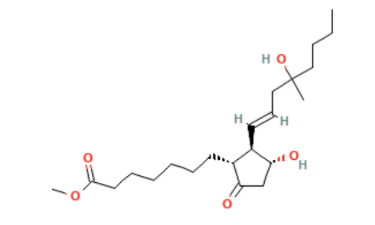
Intake routine/cycle
Daily dose
Take Misoprostol exactly as your doctor recommends. The dose may change based on your condition and how well you respond. Do not take more than prescribed without consulting your doctor.
Missed Dose
If you forget to take your medicine, take the medication as soon as you remember. If it’s nearly time for your next dose, skip the missed one and continue with your regular schedule. Always consult the doctor before making any changes to your dosage.
Overdose
It is not recommended to take more than 1.6 mg of Misoprostol per day, as it may cause severe overdosing effects like extreme drowsiness, confusion, unconsciousness, sweating, diarrhea, low blood pressure, and diarrhea. Immediately seek medical attention and meet the doctor if necessary.
Storage
- Store the medicine at room temperature
- Keep away from sunlight and moisture
- Keep out of reach of children
Directions for use
- Take Misoprostol exactly as prescribed by your doctor, at the same time each day.
- Do not stop taking Misoprostol without your doctor’s approval, even if you feel better.
- If you forget to take Misoprostol, take it as soon as you remember. If it’s almost time for your next dose, skip the missed dose.
Misoprostol Summary
Misoprostol is a medicine that protects the stomach from ulcers caused by painkillers, and doctors also use it for other purposes, like helping with miscarriage, ending a pregnancy safely under medical supervision, preparing the womb for certain procedures, starting labor, or stopping heavy bleeding after childbirth. For ulcers it works by making the stomach produce protective juices in ulcers and by causing the womb to contract in pregnancy. The most common side effects are loose stools, stomach pain, nausea, fever, or vaginal bleeding. It can be risky for pregnant women if not prescribed for a medical reason, especially those who had a cesarean before and older people may get dehydrated from diarrhea. Taking too much, around 1.6 mg or more in a day, can cause dangerous problems like severe diarrhea, low blood pressure, or very strong womb contractions, so it should only be used exactly as advised by a doctor.
FAQ’s
What are the uses of Misoprostol tablets?
Misoprostol tablets are used to prevent stomach ulcers from painkillers and to manage reproductive health needs such as inducing labor, treating miscarriage, or controlling postpartum bleeding. In short, they protect the stomach and help doctors safely manage pregnancy-related conditions.
What are the side effects of Misoprostol tablets?
Common side effects of misoprostol tablets include diarrhea, abdominal pain, nausea, vomiting, and uterine cramping; serious risks include miscarriage, birth defects, premature birth, or uterine rupture if used in pregnancy without medical supervision.
What is the maximum dose of Misoprostol per day?
The maximum safe daily dose of misoprostol is 800 mcg; doses above 1600 mcg/day can cause severe side effects like diarrhea, dehydration, low blood pressure, seizures, or uterine rupture.
What is the drug class of Misoprostol medication?
Misoprostol belongs to the drug class Miscellaneous gastrointestinal agents and is a synthetic prostaglandin E1 analogue.
Reference
- Misoprostol. In: Stat Pearls [Internet]. Treasure Island (FL): Stat Pearls Publishing; 2025 Jan. Available from.
- Drugs.com. Misoprostol: Uses, Dosage, Side Effects [Internet]. Drugs.com; c1996–2025 [updated 2025 Nov 30; cited 2025 Dec 3]. Available from.
- Mayo Clinic. Misoprostol (oral route): Description and proper use [Internet]. Rochester (MN): Mayo Foundation for Medical Education and Research; c1998–2025 [updated 2025 Nov 1; cited 2025 Dec 3]. Available from.
- Tang OS, Gemzell-Danielsson K, Ho PC. Misoprostol: pharmacokinetic profiles, effects on the uterus and side-effects. Int J Gynae Col Obstet [Internet]. 2007 Nov;99 Suppl 2:S160–7. Available from.
- National Center for Biotechnology Information (NCBI). PubChem Compound Summary for CID 5282381, Misoprostol [Internet]. Bethesda (MD): National Library of Medicine; [cited 2025 Dec 3]. Available from.
Authors



Siva Krishna Adithya Bhumireddy completed a Bachelor of Pharmacy from GIET School of Pharmacy, affiliated with Andhra University, and from his 3rd year of graduation, he was working as a freelance medical and publication writer. Having expertise in systematic reviews and clinical research. With his keen interest and skills in research and documentation practices, he also reviewed more than 150 manuscripts from international journals like Elsevier, Springer Nature, and Sage Journals, and all the manuscripts were indexed and appeared in PubMed, Scopus, and Web of Science databases, and he received honorary recognition letters and certificates from all of them. Siva Krishna Adithya also published a few systematic, narrative reviews and a few chapters of international expertise.