Category- Allopathy
Medicine Highlights
| Uses | 1. To kill bacteria and fungal infections on skin 2. To treat acne |
| Common Side Effects | 1. Redness of skin |
| Additional Information | 1. To be used for external application only. |
| Storage | 1. The medicine should be stored at room temperature 2. Keep away from sunlight and moisture 3. Keep away from the reach of children |
| How to Take This Medicine | The soap should be applied on the skin or affected part of the skin. |
Triclosan Uses
Triclosan 0.5% is a topical soap belonging to the class of antibacterial soaps and used for maintaining hygiene and killing different bacterial and fungal infections on skin.
Triclosan side effects
More Common
- Redness of Skin
Less Common
- Hormone disruption
- Antibiotic resistance
How Triclosan works
Triclosan soap is an antiseptic cleanser used to kill bacteria and fungi on the skin and help prevent the spread of infections. It works by disturbing the protective wall of germs, making them unable to survive.
Safety Measures and Warning
Allergy or Hypersensitivity
If you have previously had an allergy to this soap, inform your doctor.
Pregnancy
It is considered safe to use during pregnancy
Breastfeeding
It is safe to use while breastfeeding.
Triclosan Interaction with Food Product
Avoid smoking and consuming alcohol after taking this medicine, as they fluctuate the level of blood glucose levels by affecting the liver and pancreas.
Triclosan Interaction with Other Medicines
Triclosan does not interact with food products, as it can be applied on the skin only. So, it is safe to use without any fear of food interactions.
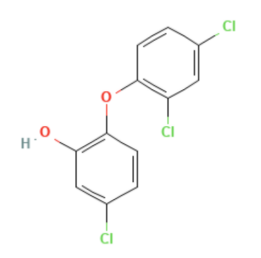
Triclosan Chemical Structure
IUPAC (International Union of Pure and Applied Chemistry)/ Chemical name
5-chloro-2-(2,4-dichlorophenoxy)phenol
Intake routine/cycle
Daily dose
Take triclosan exactly as your doctor recommends. The dose may change based on your condition and how well you respond. Do not take more than prescribed without consulting your doctor.
Missed Dose
If you forget to take your medicine, take the medication as soon as you remember. If it’s nearly time for your next dose, skip the missed one and continue with your regular schedule. Always consult the doctor before making any changes to your dosage.
Overdose
Use triclosan soap as per the doctor’s instructions; do not consume orally. If ingested orally by mistake, overdose symptoms may occur and include nausea, irritations, and vomiting; excessive skin application causes marks on skin and burning sensations.
Storage
- Store the medicine at room temperature.
- Keep away from sunlight and moisture.
- Keep out of reach of children.
Directions for use
- Do not apply in the eye
- Make sure to apply evenly on the skin
- Do not stop using this medicated cream immediately unless allergic; complete the full course
Triclosan Summary
Triclosan soap is an antiseptic cleanser used to kill bacteria and fungi on the skin and help prevent the spread of infections. It works by disturbing the protective wall of germs, making them unable to survive. While it is effective for hygiene, it can sometimes cause skin irritation, redness, or itching and should be avoided if you are allergic or develop blisters or peeling. To use, wash your hands and the affected area with water, apply the soap gently, leave it on for 2–3 minutes, then rinse thoroughly, taking care to avoid eyes, ears, open wounds, or burnt skin.
FAQ’s
What are the uses of triclosan medicated soap?
Triclosan medicated soaps are used to reduce bacterial contamination and prevent skin infections by disrupting bacterial cell membranes. They’re commonly applied for hygiene in clinical settings, though routine use is discouraged due to concerns over resistance and long-term safety.
Can triclosan be used daily?
Triclosan soap is not recommended for daily use because plain soap and water work just as well for routine cleaning. Using it every day may cause skin irritation and contribute to bacterial resistance or hormone effects.
What does triclosan do to skin?
Triclosan on the skin kills harmful bacteria and fungi, helping to prevent infections and odor. With frequent use, it may also strip away natural oils and disturb the skin’s healthy balance. This can lead to dryness, redness, itching, or allergic reactions in sensitive people.
Reference
- Shrestha P, Zhang Y, Chen WJ, Wong TY. Triclosan: antimicrobial mechanisms, antibiotic interactions, clinical applications, and human health. J Environ Sci Health C Toxicol Carcinog. 2020;38(3):245-268. Available from.
- Practo. Triclosan – Uses, Dosage, Side Effects, Price, Composition [Internet]. [cited 2025 Sep 18]. Available from.
- Drugs.com. Triclosan – brand name list from Drugs.com [Internet]. [cited 2025 Sep 18]. Available from.
- Cleveland Clinic. Triclosan: What It Is & Effects [Internet]. Cleveland Clinic; 2022 Oct 10 [cited 2025 Sep 18]. Available from.
- National Center for Biotechnology Information. PubChem Compound Summary for CID 5564, Triclosan [Internet]. Bethesda (MD): National Library of Medicine (US); [cited 2025 Sep 18]. Available from.
Authors



Siva Krishna Adithya Bhumireddy completed a Bachelor of Pharmacy from GIET School of Pharmacy, affiliated with Andhra University, and from his 3rd year of graduation, he was working as a freelance medical and publication writer. Having expertise in systematic reviews and clinical research. With his keen interest and skills in research and documentation practices, he also reviewed more than 150 manuscripts from international journals like Elsevier, Springer Nature, and Sage Journals, and all the manuscripts were indexed and appeared in PubMed, Scopus, and Web of Science databases, and he received honorary recognition letters and certificates from all of them. Siva Krishna Adithya also published a few systematic, narrative reviews and a few chapters of international expertise.