Category- Allopathy
Medicine Highlights
| Uses | 1. To treat conjunctivitis 2. To treat keratitis |
| Common Side Effects | 1. Burning of eye |
| Additional Information | Avoid consuming alcohol, tobacco, and cranberries with this medicine. |
| Storage | 1. The medicine should be stored at room temperature 2. Keep away from sunlight and moisture 3. Keep away from the reach of children |
| How to Take This Medicine | Pour the medicine drop wise in your eye |
Ofloxacin Summary
Ofloxacin 0.3% eye drop is an antibiotic used to treat bacterial infections in the eyes. It works by stopping bacteria from multiplying and spreading. Take it exactly as your doctor prescribes, at the same time each day, and don’t stop early, even if you feel better. Common side effects include nausea, headache, dizziness, and diarrhea. Serious side effects are rare but can include seizures, vision changes, or unusual bleeding; see a doctor if these occur.
If you’re pregnant or have kidney problems, let your doctor know before taking ofloxacin. Avoid alcohol and certain other medications while on it, as they may interfere with how the drug works. Store it in a cool, dry place, away from children. If you miss a dose, take it when you remember, unless it’s almost time for the next one. In case of overdose, symptoms like drowsiness, slurred speech, or swelling may occur, get medical help immediately.
Ofloxacin Uses
Ofloxacin 0.3% is an Opthalmic medicine belonging to the class of fluroquinolone medicines. It is used for following indications:
- Bacterial infection in the white portion of the eye (Conjunctivitis)
- Ulcer or opening in the eye (corneal ulcer/ keratitis)
Directions for use
- Take ofloxacin exactly as prescribed by your doctor, regularly at the same time each day.
- Do not stop taking ofloxacin without your doctor’s approval, even if you feel better.
- If you forget to take the medicine, take it as soon as you remember. Unless it’s almost time for the next one, then just skip it.
Ofloxacin side effects
More Common
- Burning of eye
Less Common
- Blurred vision
- eye pain
- feeling of something in the eye
- increased sensitivity of eye to light
- redness, irritation, or itching of eye, eyelid, or inner lining of eyelid
- stinging, tearing, or dryness of eye
How Ofloxacin works
Ofloxacin is a bacteria-killing medicine. It works by inhibiting the function of two enzymes in bacteria: topoisomerase II (DNA gyrase) and topoisomerase IV. One enzyme helps in the coiling of bacterial DNA, and the other helps in linking the two strands of DNA. By inhibiting these enzymes, bacteria cannot replicate further and will die.
Safety Measures and Warning
Pregnancy
This medicine should not be taken during pregnancy, as it can cross the placenta and may cause fetal abnormalities. If you are pregnant or planning to conceive, inform your doctor about your condition.
Kidney Dysfunction
If you have kidney disease, inform your doctor, as this medicine is excreted through the kidneys. In people with existing kidney problems, it may be harder for the kidneys to process the drug effectively.
Ofloxacin Interaction with Other Medicines
Avoid taking ofloxacin 0.3% with the following medicines, as it may increase or decrease the desired effect, or in worse cases, it could be fatal:
Ofloxacin Interaction with Food Product
You should avoid taking alcohol or tobacco with this medicine as it may increase or decrease the effect of ofloxacin.
Storage
- The medicine should be stored at room temperature
- Keep away from sunlight and moisture
- Keep away from the reach of children
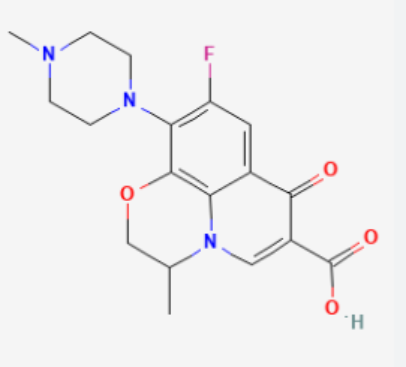
Ofloxacin Chemical Structure
IUPAC (International Union of Pure and Applied Chemistry)/ Chemical name
(RS)-7-fluoro-2-methyl-6-(4-methylpiperazin-1-yl)-10-oxo-4-oxa-1-azatricyclo[7.3.1.05,13]trideca-5(13),6,8,11-tetraene-11-carboxylic acid
Intake routine/cycle
Daily Dose
Take ofloxacin exactly as your doctor recommends. The dose may change based on your condition and how well you respond. Do not take more than prescribed without consulting your doctor.
Missed Dose
If you forget to take your medicine, take the medication soon as you remember. If it’s nearly time for your next dose, skip the missed one and continue with your regular schedule. Always consult the doctor before making any changes to your dosage.
Overdose
Although research is still ongoing to determine the exact overdose amount of ofloxacin, you should never take more than what your doctor has prescribed. Symptoms of overdose may include drowsiness, nausea, hot and cold flashes, swelling, and slurred speech. If someone taking this medicine shows these symptoms, take them to the hospital immediately.
FAQ’s
What are the uses of ofloxacin ophthalmic solution?
Ofloxacin ophthalmic solution is an antibiotic eye drop used to treat bacterial eye infections like conjunctivitis and corneal ulcers by stopping the growth of bacteria and relieving symptoms such as redness, irritation, and discharge.
Reference
- WebMD. Ofloxacin Oral: Uses, Side Effects, Interactions, Pictures, Warnings & Dosing [Internet]. WebMD; [cited 2025 Jun 11]. Available from.
- Kohler RB, Arkins N, Tack KJ. 1991. Accidental overdose of intravenous ofloxacin with benign outcome. Antimicrob Agents Chemother 35: Available from.
- Mayo Clinic. Ofloxacin (oral route) [Internet]. Rochester (MN): Mayo Clinic; [updated last week; cited 2025 Jun 11]. Available from.
- Graham DB, Tripp J. Ofloxacin. [Updated 2023 Jun 26]. In: StatPearls [Internet]. Treasure Island (FL): StatPearls Publishing; 2025 Jan-. Available from.
Authors


Mahak Phartyal completed her bachelor’s in pharmacy from Veer Madho Singh Bhandari Uttarakhand Technical University. She previously worked as a Medical Writer at Meril Life Sciences, where she wrote numerous scientific abstracts for conferences such as India Live 2024 and the European Society of Cardiology (ESC). During her college years, she developed a keen research interest and published an article titled “Preliminary Phytochemical Screening, Physicochemical and Fluorescence Analysis of Nyctanthes arbor-tristis and Syzygium cumini Leaves.