Category- Allopathy
Medicine Highlights
| Uses | 1. To treat Major depressive disorder 2. To treat anxiety 3. To control post-traumatic stress disorder 4. To treat insomnia (sleeplessness) 5. To treat irritable bowel syndrome 6. To control migraine 7. To control bladder pains, 8. To treat all types of nerve pains. |
| Common Side Effects | 1. Constipation 2. Inability to empty your bladder 3. Dry mouth 4. Drowsiness 5. Dizziness 6. Confusion 7. Blurred vision 8. Nausea and vomiting |
| Additional Information | 1. Consume the medicine at bedtime to get maximum effect with fewer side effects. |
| Storage | 1. The medicine should be stored at room temperature 2. Keep away from sunlight and moisture 3. Keep away from the reach of children |
| How to Take This Medicine | The medicine should be taken orally |
Amitriptyline Summary
Amitriptyline is a prescription medicine that belongs to a group called tricyclic antidepressants, mainly used to treat depression, but it also helps with nerve pain, migraine prevention, irritable bowel syndrome, bladder pains, and sleeplessness (insomnia). It works by boosting natural chemicals in the brain, like serotonin and norepinephrine, that improve mood and reduce pain signals. This helps people feel better emotionally and physically. Common side effects include dry mouth, drowsiness, constipation, blurred vision, weight gain, and trouble urinating. People who’ve had a recent heart attack, have serious heart rhythm issues, liver problems, glaucoma, or a history of seizures should avoid consuming it unless a doctor says it’s safe. Amitriptyline can interact with many other medicines, especially those for depression, anxiety, sleep, or pain, so it’s important to tell your doctor everything you’re taking. Alcohol should be avoided, as it can make side effects worse, like dizziness or confusion. Never stop the medicine suddenly, as it can cause withdrawal symptoms.
Amitriptyline Uses
Amitriptyline 10 mg is an oral medicine belonging to the category of tricyclic antidepressants and is used for the following indications:
- Depression
- Depression-associated anxiety
- Insomnia (Sleeplessness)
- Migraine
- Irritable bowel syndrome
- Bladder pains
- Nerve pains
Amitriptyline side effects
More Common
- Constipation
- Inability to empty your bladder
- Dry mouth
- Drowsiness
- Dizziness
- Confusion
- Blurred vision
- Nausea and vomiting
Less Common
- Breathing problems or wheezing
- Racing heart
- Fever or general ill feeling
- Swollen lymph nodes
- Swelling of the face, lips, mouth, tongue, or throat
- Trouble swallowing or throat tightness
- Itching, skin rash, or pale red bumps on the skin called hives
- Nausea or vomiting
- Dizziness, feeling lightheaded, or fainting
- Stomach cramps
- Joint pain
- Suicidal thoughts
- Increased mood
- Arrhythmia
Directions for use
- Take Amitriptyline exactly as prescribed by your doctor, regularly at the same time each day.
- Do not stop taking Amitriptyline without your doctor’s approval, even if you feel better.
- If you forget to take the medicine, take it as soon as you remember. Unless it’s almost time for the next one, then just skip it.
How Amitriptyline works
Amitriptyline works by boosting the brain’s natural feel-good chemicals, like serotonin and norepinephrine. In depression or nerve pain, these chemicals decrease. Normally, the brain clears them away quickly like a vacuum. Amitriptyline slows this process down, helping the chemicals stay longer and do their job. This lifts mood and eases pain.
Safety Measures and Warning
1- Pregnancy
Amitriptyline is not confirmed safe for use during pregnancy. It’s classified as a Category C drug, meaning animal studies suggest possible risks like heart defects or miscarriage, but human data is lacking. Always consult a doctor before using it.
2- Breastfeeding
Amitriptyline passes into breast milk. Inform your healthcare provider if you are breastfeeding or planning to breastfeed. They will advise you whether to stop breastfeeding or discontinue amitriptyline.
3- Heart Problems
Amitriptyline can affect the functioning of the heart and can reduce blood pressure. So, get a recommendation from the doctor before using it.
4- Past Mental Health Issues
Patients having past mental health problems can experience potential side effects and symptoms like confusion and hallucinations, so inform your doctor before using.
Amitriptyline Interaction with Food Product
Avoid consuming alcohol and smoking, as they increase or decrease drug action and can also cause severe drowsiness and sedation, as they act on the brain directly. Take the patient to the doctor in case of any side effects.
Amitriptyline Interaction with Other Medicines
Avoid taking Amitriptyline10 mg with the following medicines, as it may increase or decrease the desired effect, or in worse cases, it could be fatal:
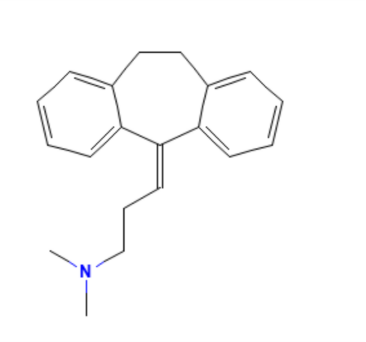
Amitriptyline Chemical Structure
IUPAC (International Union of Pure and Applied Chemistry)/ Chemical name
3-(10,11-dihydro-5H-dibenzo[a,d]cycloheptene-5-ylidene)-N,N-dimethyl-1-propanamine.
Intake routine/cycle
Daily Dose
Take Amitriptyline exactly as your doctor recommends. The dose may change based on your condition and how well you respond. Do not take more than prescribed without consulting your doctor.
Missed Dose
If you forget to take your medicine, take the medication as soon as you remember. If it’s nearly time for your next dose, skip the missed one and continue with your regular schedule. Always consult the doctor before making any changes to your dosage.
Overdose
Don’t take more than 300 mg of Amitriptyline per day, as it may cause severe adverse effects like extreme drowsiness, confusion, low blood pressure, unconsciousness, difficulty in breathing, irregular heartbeat, and vision loss.
Storage
- Store the medicine at room temperature
- Keep away from sunlight and moisture
- Keep out of reach of children
FAQ’s
1. What are the side effects of Amitriptyline tablets?
Amitriptyline, commonly used for the treatment of depression and anxiety, can also have side effects that include severe drowsiness, mania, and arrhythmias. So, people should be careful while taking medicine.
2. What is an amitriptyline overdose?
Taking more than 300 mg causes overdose and produces toxic effects like fall in pressure, unconsciousness, numbness, and vision problems
3. What does amitriptyline’s long-term use cause?
It causes dependence, trouble sleeping, and addiction-seeking behaviors.
4. Which category of medicine does Amitriptyline belong to?
Amitriptyline belongs to the category of tricyclic antidepressants and is used to treat depression and anxiety, but it should only be used under medical prescription.
Reference
- National Center for Biotechnology Information. PubChem Compound Summary for CID 2160, Amitriptyline [Internet]. Bethesda (MD): National Library of Medicine (US); [cited 2025 Jun 30]. Available from.
- Wishart DS, Knox C, Guo AC, Shrivastava S, Hassanali M, Stothard P, et al. Drug Bank: a comprehensive resource for in silico drug discovery and exploration. Nucleic Acids Res. 2006 Jan 1;34(Database issue):D668–72. Available from.
- WebMD. Amitriptyline oral: Uses, side effects, interactions, pictures, warnings and dosing [Internet]. WebMD; [cited 2025 Jun 30]. Available from.
- Drugs.com. Amitriptyline: Uses, dosage, side effects and interactions [Internet]. Drugs.com; [cited 2025 Jun 30]. Available from.
Authors



Siva Krishna Adithya Bhumireddy completed a Bachelor of Pharmacy from GIET School of Pharmacy, affiliated with Andhra University, and from his 3rd year of graduation, he was working as a freelance medical and publication writer. Having expertise in systematic reviews and clinical research. With his keen interest and skills in research and documentation practices, he also reviewed more than 150 manuscripts from international journals like Elsevier, Springer Nature, and Sage Journals, and all the manuscripts were indexed and appeared in PubMed, Scopus, and Web of Science databases, and he received honorary recognition letters and certificates from all of them. Siva Krishna Adithya also published a few systematic, narrative reviews and a few chapters of international expertise.