Category- Allopathy
Medicine Highlights
| Uses | 1- To treat ulcer in stomach and large intestine (Duodenal ulcer) |
| Common Side Effects | 1- Constipation 2- Nausea 3- Vomiting 4- Flatulence 5- Headache 6- Dry mouth 7- Skin Rash |
| Additional Information | Avoid taking alcohol or tobacco with this medicine. |
| Storage | 1- The medicine should be stored at room temperature 2- Keep away from sunlight and moisture 3- Keep away from the reach of children |
| How to Take This Medicine | The medicine should be taken orally |
Sucralfate Summary
Sucralfate 100 mg/ml is an taken orallyused for duodenal ulcers and dyspepsia. It coats ulcers, neutralizes acid, and blocks harmful enzymes, forming a protective barrier for healing.
Common side effects include constipation, nausea, vomiting, headache, and dry mouth. Less common effects include dizziness, bloating, indigestion, hives, and sleep disturbances.
Patients with allergies or diabetes should consult their doctor. Avoid combining sucralfate with certain drugs, and avoid alcohol.
Sucralfate Uses
Sucralfate 100 mg/ml is an oral medicine belonging to the class of protectants medicines. It is used for following indications:
- Ulcer in large intestines (Duodenal ulcer)
- Ulcer in stomach
Sucralfate side effects
More Common
- Constipation
- Nausea
- Vomiting
- Flatulence
- Headache
- Dry mouth
- Skin Rash
Less Common
- Back ache
- Bloated
- Constipation
- Diarrhea
- Dizziness or lightheadedness
- Excess air or gas in the stomach or intestines
- Feeling of constant movement of self or surroundings
- Headache
- Hives, itching, skin rash
- Indigestion
- Passing gas
- Sensation of spinning
- Sleepiness
- Stomach cramps
- Trouble sleeping
How Sucralfate works
Sucralfate is an anti-ulcer drug that works in four ways. First, it prevents the breakdown of water and absorbs an acid called pepsin from the stomach, decreasing its concentration. Second, it forms a gel-like barrier over the ulcer, protecting it from acid damage. Third, it increases mucus secretion from prostaglandin-producing cells. Lastly, it promotes the growth of new cells over the mucus, helping to heal the ulcer.
Safety Measures and Warning
1- Allergy/Hypersensitivity
If you develop symptoms like swelling, redness, or itchiness, you may be allergic to this medicine and should inform your doctor.
2- Diabetes
If you are diabetic, inform your doctor, as this medication may increase blood sugar levels.
Sucralfate Interaction with Other Medicines
Avoid taking sucralfate 100 mg/ ml with the following medicines, as it may increase or decrease the desired effect, or in worse cases, it could be fatal:
Sucralfate Interaction with Food Product
Sucralfate does not interact with any food products, but alcohol should be avoided before and after taking the medicine, as it can increase or decrease the effect of sucralfate.
Storage
- The medicine should be stored at room temperature
- Keep away from sunlight and moisture
- Keep away from the reach of children
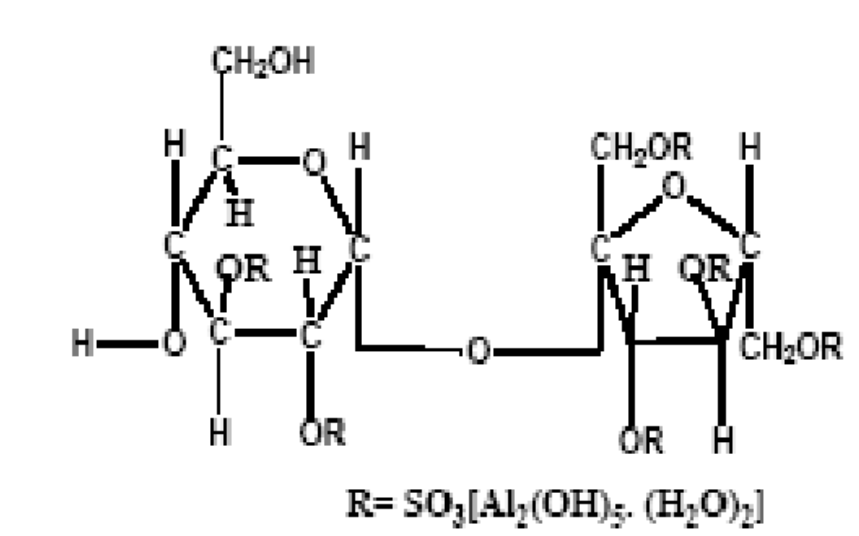
Sucralfate Chemical Structure
IUPAC (International Union of Pure and Applied Chemistry)/ Chemical name-
Hexadeca-μ-hydroxytetracosahydroxy[μ8-[1,3,4,6-tetra-O-sulfo-β-Dfructofuranosyl-α-D-glucopyranoside tetrakis(hydrogen sulfato)8-)]]hexadecaaluminum
Intake routine/cycle
Daily Dose
Take sucralfate exactly as your doctor recommends. The dose may change based on your condition and how well you respond. Do not take more than prescribed without consulting your doctor.
Missed Dose
If you forget to take your medicine, take the medication soon as you remember. If it’s nearly time for your next dose, skip the missed one and continue with your regular schedule. Always consult the doctor before making any changes to your dosage.
Overdose
If you take more than the recommended dose of sucralfate, you may experience symptoms such as indigestion, nausea, vomiting, and abdominal pain.
FAQ’
1- How to Take Sucralfate?
You should take this medicine on an empty stomach, one hour before a meal, to avoid the direct interaction between the ulcer and food. Shake well before using it.
2- What Is Sucralfate Suspension Used For?
It is used to treat stomach and duodenal ulcers (ulcers in the small intestine).
3- Can Sucralfate Cause Constipation?
Yes, constipation is one of the side effects of sucralfate because it slows down the movement of water and other fluids in the digestive tract, resulting in constipation.
Reference
- Nagashima R. Mechanisms of action of sucralfate. J Clin Gastroenterol. 1981;3(Suppl 2):117-27. PMID: 6798100. Available from.
- Kudaravalli P, Patel P, John S. Sucralfate. [Updated 2024 Feb 28]. In: StatPearls [Internet]. Treasure Island (FL): StatPearls Publishing; 2025 Jan-. Available from.
- Kudaravalli P, Patel P, John S. Sucralfate. [Updated 2024 Feb 28]. In: StatPearls [Internet]. Treasure Island (FL): StatPearls Publishing; 2025 Jan-. Available from.
- Mayo Clinic. Sucralfate (Oral Route) – Description and Brand Names [Internet]. Rochester (MN): Mayo Foundation for Medical Education and Research; [cited 2025 Apr 2]. Available from.
Authors


Mahak Phartyal completed her bachelor’s in pharmacy from Veer Madho Singh Bhandari Uttarakhand Technical University. She previously worked as a Medical Writer at Meril Life Sciences, where she wrote numerous scientific abstracts for conferences such as India Live 2024 and the European Society of Cardiology (ESC). During her college years, she developed a keen research interest and published an article titled “Preliminary Phytochemical Screening, Physicochemical and Fluorescence Analysis of Nyctanthes arbor-tristis and Syzygium cumini Leaves.